
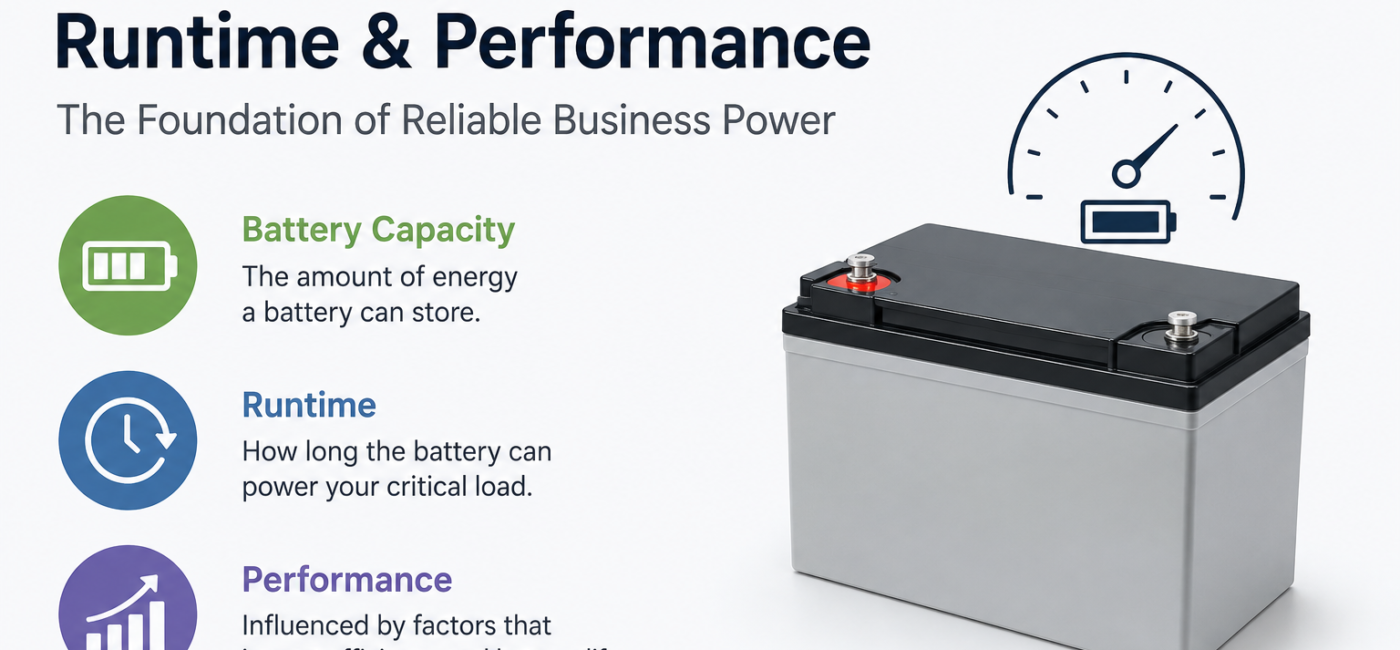
Reliable power is not only an engineering concern. For many businesses, it is directly connected to uptime, safety, customer service, production output, data protection, and revenue continuity.
This is why battery capacity matters when designing backup power solutions, UPS systems, industrial battery banks, and wider energy storage solutions. Yet many businesses still make the mistake of looking only at battery size. A larger battery may look reassuring on paper, but actual backup performance depends on much more than the number printed on the battery label.
Runtime, load demand, discharge rate, temperature, battery efficiency, charging quality, battery age, and maintenance practices all influence how long a battery power system can support critical equipment.
This guide explains battery capacity in clear business language. It will help facility managers, engineers, procurement teams, and decision makers understand how capacity relates to battery runtime, battery performance, battery life, and long-term power reliability.
What Does Battery Capacity Really Mean?
Battery capacity refers to the amount of electrical energy a battery can store and deliver under specific conditions. In simple terms, it tells you how much usable power is available before the battery needs to be recharged.
Capacity is commonly expressed in two ways:
Ampere-hours Ah
Ampere-hours, usually written as Ah, show how much current a battery can provide over time.
For example, a 100Ah battery could theoretically deliver 10 amps for 10 hours, or 20 amps for 5 hours. In real operating conditions, the result may be different because batteries are affected by discharge rate, temperature, age, and system efficiency.
Watt-hours Wh
Watt-hours give a clearer picture of stored energy because they include voltage.
The basic formula is:
Watt-hours = Voltage × Ampere-hours
A 12V, 100Ah battery stores approximately 1,200Wh of energy. A 48V, 100Ah battery stores approximately 4,800Wh. Both may have the same Ah rating, but they do not store the same amount of energy.
This is one reason battery capacity should never be judged by Ah alone. Voltage and load demand must also be considered.
Stored energy explained with a simple analogy
Think of a battery as a water tank.
Capacity is the size of the tank. Load is the speed at which water is being used. Runtime is how long the tank lasts before it becomes empty.
A larger tank usually lasts longer, but only if the water flow remains the same. If the connected equipment draws heavy power, even a large battery bank can discharge quickly.
That is why higher battery capacity does not automatically mean longer runtime in every situation.
Battery Capacity vs Battery Runtime
Battery capacity and battery runtime are closely related, but they are not the same.
Capacity tells you how much energy is stored. Runtime tells you how long that stored energy can support the connected load.
A simple runtime estimate looks like this:
Runtime hours = Usable battery energy ÷ Load demand
For backup power systems, a more practical version is:
Runtime hours = Usable watt-hours × System efficiency ÷ Load watts
This means a battery system with 10,000Wh of stored energy will not necessarily deliver the full 10,000Wh to equipment. Some energy is lost through cables, UPS electronics, inverters, heat, and internal battery resistance.
How connected load affects runtime
The connected load has the biggest influence on battery runtime.
A UPS battery supporting a small network cabinet may last much longer than the same battery supporting servers, cooling fans, security systems, and communication equipment together.
For example:
A 5kW load will drain the same battery system much faster than a 1kW load.
This is why critical power systems should always be sized based on actual load analysis, not guesswork.
Why voltage matters
Battery voltage affects the total stored energy and how efficiently power is delivered.
Industrial batteries are often configured into battery strings to match the voltage requirements of UPS systems, telecom equipment, DC power systems, or battery power systems used in manufacturing plants.
A higher-voltage battery bank can support larger loads more efficiently when properly designed. However, it also requires correct protection, safe installation, and professional maintenance.
Practical examples
In a UPS system, battery capacity determines how long servers, switches, medical equipment, control systems, or security devices remain powered during an outage.
In telecom, batteries may need to support base stations or communication cabinets for several hours during grid failure.
In manufacturing, industrial power backup may be required long enough to stop machinery safely, protect automation systems, or bridge power until a generator starts.
In commercial buildings, battery backup may support emergency lighting, access control, fire alarm panels, IT systems, elevators, or essential business equipment.
Each case has a different runtime target. The right battery capacity depends on what must remain operational and for how long.
Factors That Affect Battery Performance
Battery performance is shaped by operating conditions. Two batteries with the same capacity rating can perform differently if they are installed, charged, discharged, and maintained under different conditions.
Load Size
Heavy loads reduce runtime quickly.
When a battery is discharged at a higher current, it may deliver less usable capacity than expected. This is especially relevant for lead acid batteries, UPS batteries, and industrial batteries supporting motors, pumps, servers, and high-demand electrical loads.
Light loads usually allow longer runtime, but the system must still be designed correctly. Oversizing without purpose can increase cost, space requirements, and maintenance work.
Temperature
Temperature has a major impact on battery efficiency, battery life, and available capacity.
High temperatures can accelerate battery aging. This may shorten service life even if the battery appears to perform well at first.
Cold temperatures can reduce available capacity and make batteries less responsive during discharge.
For critical power systems, battery rooms should be properly ventilated, monitored, and controlled. A battery that operates in a stable environment is more likely to deliver predictable backup performance.
Depth of Discharge
Depth of discharge refers to how much of the battery’s stored energy is used before recharging.
A shallow discharge uses only a small portion of capacity. A deep discharge uses a larger portion.
Frequent deep discharges can reduce battery life, especially in lead acid batteries. For business continuity applications, the goal is not only to achieve the required runtime but also to protect long-term reliability.
A battery bank that is repeatedly pushed to its limits may need earlier replacement.
Battery Age
Battery capacity reduces gradually over time.
As batteries age, internal resistance increases and the amount of usable stored energy decreases. This means an older battery may still show normal voltage but fail to deliver expected runtime under load.
For UPS batteries and industrial batteries, this is one of the main reasons periodic testing is necessary. Visual inspection alone cannot confirm true battery performance.
Charging Practices
Correct charging helps preserve battery life.
Undercharging can leave batteries in a weakened state. Overcharging can create heat, water loss in certain battery types, and accelerated wear.
Charging settings must match the battery type, manufacturer recommendations, system design, and operating temperature. This is especially important in battery power systems used for standby applications.
Maintenance
Maintenance improves reliability by identifying problems before they become failures.
For lead acid batteries, inspections may include checking terminal condition, torque, voltage readings, float charging performance, electrolyte levels where applicable, swelling, leakage, corrosion, and environmental conditions.
For modern battery systems, monitoring software can add visibility into battery health, trends, and warning signs.
A well-maintained battery bank is more dependable than a larger battery bank that is ignored.
Understanding Battery Efficiency
Battery efficiency describes how much of the energy put into a battery can later be recovered and used.
No battery is 100 percent efficient. Some energy is lost during charging and discharging. These losses can come from heat, chemical reactions, internal resistance, cabling, converters, and power electronics.
Charging efficiency
Charging efficiency refers to how effectively electrical energy is stored during charging.
If a system requires more energy to recharge than it later delivers, the difference becomes operating loss. Over time, those losses can affect electricity costs, cooling requirements, and overall system performance.
Discharge efficiency
Discharge efficiency refers to how effectively stored energy is delivered to the connected load.
A battery may have enough rated capacity, but poor discharge efficiency can reduce usable runtime.
Internal resistance
Internal resistance is resistance inside the battery itself.
As batteries age or degrade, internal resistance usually increases. Higher internal resistance can cause voltage drop, heat buildup, and reduced power delivery under load.
This is one reason battery testing should include more than a simple voltage check.
Why efficiency matters for operating costs
Battery efficiency affects more than backup runtime. It also influences energy consumption, cooling needs, charging time, and replacement planning.
For large commercial battery solutions, even small efficiency losses can become meaningful across multiple battery strings, UPS systems, data rooms, industrial plants, or telecom sites.
Good battery efficiency supports better power reliability and lower lifecycle cost.
Battery Capacity in Different Applications
Different industries use batteries for different reasons. Some need a few minutes of backup. Others need hours of autonomy. Some require high power for short periods, while others require steady energy delivery over longer durations.
Battery Capacity for UPS Systems
UPS systems are usually designed to protect critical equipment from outages, voltage dips, frequency disturbances, and short interruptions.
In many facilities, UPS batteries only need to support the load until a generator starts. In other cases, they must provide enough runtime for safe shutdown or continued operation.
Battery capacity for UPS systems depends on:
- Total connected load
- Required backup duration
- UPS efficiency
- Battery voltage
- Battery type
- Redundancy requirements
- Future load growth
- Maintenance strategy
For IT infrastructure, even a few minutes of reliable runtime can prevent data loss and equipment shutdown. For hospitals, industrial controls, and security systems, runtime requirements may be more demanding.
Battery Capacity for Data Centers
Data centers rely on critical power systems where downtime can be extremely costly.
Battery capacity must support servers, storage systems, networking equipment, monitoring platforms, and supporting infrastructure long enough for generators or alternative backup systems to take over.
Data center managers also need to consider redundancy. A design may include N+1 or 2N arrangements, depending on risk tolerance and uptime requirements.
In this environment, battery runtime is not only a technical metric. It is part of service availability, customer trust, and contractual performance.
Battery Capacity for Telecommunications
Telecom networks require dependable battery power systems because communication must continue during grid interruptions.
Telecom batteries may support base stations, transmission equipment, routers, microwave links, fiber nodes, and outdoor cabinets.
Capacity planning should consider site location, grid reliability, access difficulty, temperature exposure, and repair response time.
Remote telecom sites may require longer battery runtime because maintenance teams cannot always reach the site immediately.
Battery Capacity for Healthcare Facilities
Hospitals and healthcare facilities depend on backup power for patient safety.
Battery systems may support medical devices, operating rooms, emergency lighting, nurse call systems, monitoring equipment, IT networks, laboratories, and life safety systems.
Healthcare battery capacity must be planned with strict attention to critical load classification. Not every load has the same priority.
The objective is to maintain essential services safely while generators, transfer switches, and wider backup power solutions operate as intended.
Battery Capacity for Manufacturing Plants
Manufacturing facilities use industrial batteries for automation systems, process controls, PLCs, emergency shutdown systems, security systems, communication panels, and sometimes material handling equipment.
Power interruptions can stop production, damage materials, disrupt quality control, or create safety risks.
For manufacturing plants, battery capacity should be matched to the operational goal. Some systems need enough runtime for controlled shutdown. Others need continued operation until utility power returns or generator power stabilizes.
Battery Capacity for Warehouses
Warehouses often depend on lighting, access control, security systems, fire protection panels, IT networks, conveyor controls, scanning systems, and loading dock equipment.
Battery backup supports operational continuity and safety during outages.
For logistics companies, even short interruptions can delay dispatch, inventory updates, and delivery schedules. Battery runtime planning should reflect the business impact of downtime, not only the electrical load.
Battery Capacity for Commercial Buildings
Commercial buildings use battery backup for emergency lighting, elevators, access systems, fire alarms, surveillance systems, network equipment, and essential office operations.
Battery capacity requirements vary depending on building size, occupancy, safety codes, tenant expectations, and the availability of generator backup.
Facility managers should review both technical loads and business priorities when planning commercial battery solutions.
Lead Acid Batteries and Battery Capacity
Lead acid batteries remain widely used in UPS systems, telecom power, industrial power backup, emergency lighting, switchgear, and many stationary standby applications.
Their continued use is not accidental. Lead acid batteries are familiar, widely available, cost effective, recyclable, and supported by a large maintenance and service ecosystem.
Capacity characteristics
Lead acid battery capacity is affected by discharge rate, temperature, battery age, charging method, and depth of discharge.
A battery may be rated at a specific capacity under controlled conditions. Actual performance in the field may differ if the load is heavier, the room is too hot, or the battery has aged.
Reliability
When correctly selected, installed, charged, and maintained, lead acid batteries can provide dependable standby power.
They are commonly used where predictable backup is more important than frequent cycling.
Cost effectiveness
Lead acid batteries often have a lower upfront cost compared with some newer battery chemistries. This makes them attractive for many commercial and industrial battery applications.
However, procurement teams should compare lifecycle cost, maintenance requirements, space, replacement intervals, weight, and operating conditions before making a decision.
Industrial applications
Common lead acid battery applications include:
- UPS batteries
- Telecom backup power
- Emergency lighting systems
- Fire alarm backup
- Switchgear and control systems
- Industrial DC power systems
- Generator starting batteries
- Security and access control backup
The key is to match the battery type to the duty cycle. A standby UPS battery and a deep-cycle energy storage battery do not serve the same purpose.
Common Misconceptions About Battery Capacity
Battery capacity is often misunderstood. These misconceptions can lead to poor sizing, unnecessary spending, and unreliable backup power.
Bigger battery always means better
A bigger battery is not always the best answer.
If the system is poorly designed, badly ventilated, incorrectly charged, or connected to uncontrolled loads, extra capacity may not solve the real problem.
The right battery capacity is the capacity that supports the required load for the required time under real operating conditions.
Capacity never changes
Battery capacity changes with age, temperature, discharge history, and maintenance quality.
A battery that delivered 30 minutes of runtime when new may not deliver the same runtime after several years of service.
Runtime is fixed
Runtime is not fixed. It changes when the load changes.
Adding servers, lighting circuits, network switches, medical equipment, or production controls can reduce available backup time.
This is why load reviews should be part of regular power reliability planning.
All batteries perform equally
Batteries with the same voltage and Ah rating may not perform equally.
Battery chemistry, build quality, design life, internal resistance, discharge characteristics, installation quality, and maintenance history all matter.
Maintenance is not necessary
Maintenance is not optional for critical battery systems.
Even maintenance-free batteries require inspection, testing, monitoring, and replacement planning. The phrase “maintenance-free” usually means reduced routine service, not zero responsibility.
How to Choose the Right Battery Capacity
Choosing the right battery capacity requires a practical review of both electrical requirements and business risk.
A good selection process should include the following steps.
1. Identify critical equipment
List the equipment that must remain powered during an outage.
This may include servers, control panels, communication equipment, emergency systems, medical devices, production controls, security systems, or building safety equipment.
Separate essential loads from non-essential loads. This prevents unnecessary oversizing.
2. Define runtime goals
Decide how long each critical load must operate.
Some businesses need only 10 to 15 minutes for generator startup. Others need one hour, two hours, or longer because of site conditions or operational requirements.
Runtime should be based on business continuity needs, not assumptions.
3. Measure actual load
Use real load data where possible.
Nameplate ratings can be useful, but actual operating loads often differ. Measuring real demand gives a more accurate basis for sizing.
4. Consider future expansion
Battery capacity should reflect reasonable future growth.
If a data room, production line, warehouse system, or telecom site is expected to expand, the battery system should be planned with future load in mind.
However, oversizing too much can increase cost and complexity. Balance is essential.
5. Review environmental conditions
Temperature, ventilation, dust, humidity, and site access all affect battery performance.
A battery installed in a hot electrical room may age faster than one installed in a controlled environment.
6. Compare budget and lifecycle cost
Initial purchase cost is only one part of the decision.
Also consider:
- Installation cost
- Maintenance cost
- Testing cost
- Replacement intervals
- Space requirements
- Cooling needs
- Downtime risk
- Disposal or recycling requirements
A low-cost battery that fails early may become expensive over time.
7. Plan for safety
Battery systems require correct protection, isolation, ventilation, cable sizing, labeling, and safe access.
Safety should be built into the design from the beginning, especially for industrial batteries and large battery power systems.
8. Use professional battery sizing
For critical applications, battery sizing should be handled by qualified professionals.
A proper assessment considers load profile, autonomy time, battery type, efficiency losses, discharge curves, aging factors, temperature correction, and system redundancy.
Best Practices for Maximizing Battery Runtime
Good runtime is not only achieved during design. It must be protected throughout the battery’s service life.
Practical steps include:
- Test batteries at scheduled intervals.
- Monitor voltage, current, temperature, and battery condition.
- Keep battery rooms within recommended temperature limits.
- Use charging settings suitable for the battery type.
- Avoid unnecessary deep discharge.
- Reduce non-critical loads during backup operation.
- Inspect terminals, cables, racks, and protective devices.
- Clean corrosion and correct loose connections.
- Replace weak batteries before they compromise the full string.
- Use battery monitoring systems for critical sites.
- Review load growth after equipment upgrades.
- Keep maintenance records for trend analysis.
- Arrange professional inspections for UPS batteries and industrial power backup systems.
These practices improve battery runtime, support battery life, and reduce the risk of unexpected failure.
Industry Examples
Understanding battery capacity becomes easier when viewed through real business situations.
Hospitals
A hospital cannot treat backup power as a convenience. Battery systems may support patient monitoring, operating rooms, emergency lighting, IT networks, and life safety equipment.
If battery capacity is underestimated, critical systems may shut down before generator power stabilizes. Proper sizing protects patient safety and operational continuity.
Airports
Airports rely on lighting, communication systems, security screening, access control, baggage handling, control rooms, and IT infrastructure.
Battery runtime helps bridge short outages and protects essential systems from interruption. Reliable backup power solutions support passenger safety and operational flow.
Manufacturing Facilities
In manufacturing, a sudden power loss can stop production lines, damage materials, interrupt automation, or create safety hazards.
Correct battery capacity gives operators time to complete a controlled shutdown, protect PLCs, and maintain communication between control systems.
Banking and Financial Services
Banks depend on data, connectivity, security systems, ATMs, and transaction platforms.
Battery power systems help protect IT infrastructure during outages and reduce the risk of transaction disruption.
Data Centers
Data centers use battery capacity as part of a larger uptime strategy.
Batteries support IT loads until generators or alternate power sources take over. Accurate runtime planning helps prevent service interruptions and supports power reliability commitments.
Telecom Operators
Telecom operators may have hundreds or thousands of backup sites.
Battery capacity must be planned around grid reliability, site remoteness, equipment demand, and service restoration time. Poor sizing can affect network availability during extended outages.
Logistics Companies
Warehouses and logistics centers depend on scanning systems, dispatch platforms, access control, security, lighting, and loading operations.
Battery runtime helps maintain order flow and protects time-sensitive operations during power interruptions.
Future Trends in Battery Capacity and Performance
Battery technology is advancing, but battery capacity will remain a key design consideration.
New chemistries, smarter controls, and better analytics are improving how businesses manage stored energy. Still, every backup power system must answer the same practical questions: How much load must be supported? For how long? Under what conditions? At what risk level?
Smarter battery monitoring
Battery monitoring systems are becoming more common in critical power systems.
They can track voltage, temperature, internal resistance, string imbalance, discharge events, and charging behavior. This gives facility teams better visibility into battery health.
Predictive maintenance
Predictive maintenance uses operating data to identify early warning signs.
Instead of waiting for failure, businesses can plan replacements, schedule inspections, and reduce emergency service calls.
AI-assisted battery management
AI-assisted tools can help analyze performance trends across multiple sites.
For telecom networks, data centers, industrial plants, and commercial buildings, this can support better asset planning and risk management.
Battery analytics
Battery analytics can show how capacity changes over time.
This helps operations teams understand whether batteries are aging normally or showing signs of accelerated degradation.
Improved energy storage
Energy storage solutions are becoming more important for power reliability, renewable integration, and peak demand management.
While battery chemistry may change, capacity planning will still be essential. A battery system must be sized around real demand, expected runtime, operating environment, safety requirements, and business continuity goals.
Sustainable battery technologies
Sustainability is also shaping battery decisions.
Businesses are paying closer attention to recyclability, lifecycle impact, battery sourcing, disposal practices, and long-term energy efficiency.
A responsible battery strategy considers both technical performance and environmental responsibility.
Conclusion
Battery capacity is one of the most important factors in backup power planning, but it should never be viewed in isolation.
A reliable battery system depends on the correct balance of capacity, runtime, battery efficiency, discharge rate, operating temperature, charging quality, maintenance, and load management.
For business owners, facility managers, engineers, and procurement professionals, the real question is not simply “How big should the battery be?” The better question is: “What level of power reliability does this business need, and what battery system will support that requirement safely and consistently?”
When battery capacity is understood properly, businesses can make better decisions about UPS batteries, industrial batteries, backup power solutions, energy storage solutions, and critical power systems.
A thoughtful battery strategy protects more than equipment. It protects operations, safety, productivity, and business continuity.