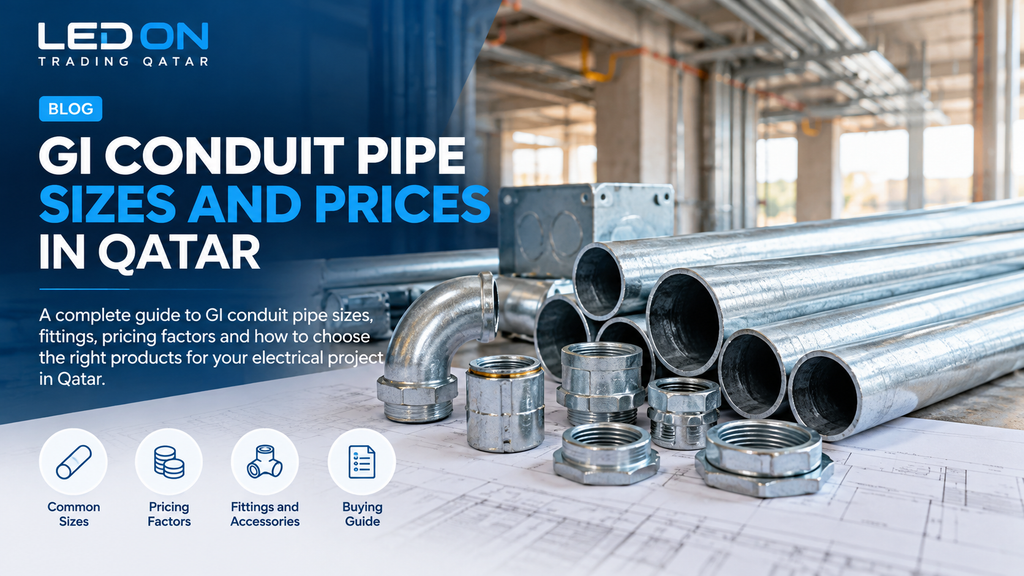
GI conduit pipes are widely used in electrical installations to protect cables from physical damage and provide a structured wiring pathway. Whether you are planning a commercial building, industrial facility, warehouse or renovation project, selecting the right GI conduit pipe in Qatar is an important part of electrical installation planning.
At LED ON Trading Qatar, customers can explore electrical conduit accessories and related products for their project requirements. This guide explains common GI conduit sizes, types of fittings, factors affecting prices and what to consider before requesting a quotation.
What Is a GI Conduit Pipe?
GI stands for galvanized iron, a term commonly used in the electrical trade for galvanized steel conduit. These conduits have a protective zinc coating that helps resist corrosion.
GI conduits are used to route and protect electrical cables in installations where mechanical protection and durability are important.
Common applications include:
- Commercial and office buildings
- Warehouses and industrial facilities
- Electrical distribution systems
- Exposed electrical wiring installations
- Building maintenance and renovation projects
The appropriate conduit type and installation method depend on the electrical design, site conditions and applicable standards.
Common GI Conduit Pipe Sizes
GI conduit pipes are available in different trade sizes to accommodate various cable quantities and installation requirements.
The following are commonly encountered nominal conduit sizes:
| Nominal trade size | Typical applications |
|---|---|
| 20 mm | Smaller wiring runs and branch circuits |
| 25 mm | General commercial electrical installations |
| 32 mm | Larger cable groups and distribution routes |
| 40 mm | Higher-capacity wiring pathways |
| 50 mm | Larger electrical distribution installations |
Important: These are general trade-size examples, not a confirmed LED ON inventory list. Exact dimensions, availability, wall thickness and permitted cable fill depend on the conduit standard and installation design.
Before choosing a size, consider the number of conductors, their outside diameters, cable fill requirements, bends and future maintenance needs.
What Affects GI Conduit Pipe Prices in Qatar?
If you are searching for GI conduit pipe prices in Qatar, you may notice that quotations vary between products and suppliers.
Several factors influence the cost.
1. Conduit diameter
Larger-diameter conduits generally require more material, which can affect their price.
2. Wall thickness and conduit type
Different conduit specifications have different material requirements and mechanical characteristics. Always compare equivalent products rather than selecting only by diameter.
3. Galvanizing and product standards
The protective coating, manufacturing quality and applicable product standard can influence pricing and suitability.
4. Quantity required
Large construction projects may require bulk quantities. The total order quantity can affect the quotation.
5. Fittings and installation accessories
A complete installation may require couplings, connectors, bends, boxes and other accessories in addition to the conduit pipes.
For current product information and enquiries, browse the EMT and GI conduit accessories category at LED ON Trading Qatar.
GI Conduit Fittings and Accessories
Selecting the correct fittings is just as important as selecting the conduit pipe.
Common conduit accessories include:
- Couplings: Connect conduit sections.
- Connectors: Connect conduits to suitable boxes or enclosures.
- Bends and elbows: Help route conduit around changes in direction.
- Locknuts and bushes: Provide secure terminations and help protect cables where applicable.
- Junction boxes: Provide suitable locations for cable connections and access.
Accessories must be compatible with the conduit type, size and installation requirements.
To learn more, read our EMT Conduit Accessories Guide in Qatar.
GI Conduit vs EMT Conduit: Which Should You Choose?
Both GI and EMT conduits are used in electrical installations, but the terminology can be confusing.
EMT is a defined thin-wall metallic electrical tubing type, while GI is a broader trade description often used for galvanized steel conduit. Consequently, the exact products being compared must be identified before making a technical decision.
Consider the following factors:
- Required mechanical protection
- Installation environment
- Applicable electrical standards
- Conduit wall thickness and material specification
- Compatible fittings and installation methods
- Project budget and maintenance requirements
For a more detailed explanation, read our EMT vs GI Conduit Comparison in Qatar.
How to Choose GI Conduit Pipes for Your Project
Before purchasing conduit materials, follow these steps.
Step 1: Review the electrical drawings
Confirm the specified conduit type, trade size, routing and installation method.
Step 2: Check cable requirements
Determine the conductor quantities and sizes, and verify the applicable cable-fill limits.
Step 3: Consider the installation environment
Check whether the conduit will be installed indoors, outdoors, in damp locations or in areas requiring additional protection.
Step 4: Select compatible accessories
Confirm that couplings, connectors, boxes and other fittings match the selected conduit system.
Step 5: Request a project-specific quotation
Provide the required sizes, quantities, specifications and accessory list to the supplier.
For additional product information, visit our EMT and GI Conduits and Accessories Guide.
Where to Enquire About GI Conduit Accessories in Qatar
LED ON Trading Qatar offers an electrical product category dedicated to conduit accessories.
Customers can explore the available product listings and contact the team to discuss requirements for commercial, residential and industrial electrical projects.
Looking for GI conduit accessories in Qatar?
Browse Conduit Accessories at LED ON Trading
Call LED ON Trading: +974 4002 0850
Contact our team for current product availability, specifications and quotations.
Frequently Asked Questions
What are the common GI conduit sizes?
Common nominal trade sizes include 20 mm, 25 mm, 32 mm, 40 mm and 50 mm. Available sizes depend on the manufacturer and product standard.
What is the price of a GI conduit pipe in Qatar?
Prices depend on the conduit diameter, specification, wall thickness, quantity and supplier. Request a quotation for current pricing.
Is GI conduit suitable for outdoor installation?
Some galvanized steel conduit systems can be suitable for outdoor applications when their specifications, fittings and installation methods meet the relevant environmental and electrical requirements.
What is the difference between EMT and GI conduit?
EMT refers to a specific thin-wall metallic tubing type. GI commonly refers to galvanized steel conduit more broadly. The actual specifications must be compared to determine their differences.
Where can I find GI conduit accessories in Qatar?
Visit the LED ON Trading conduit accessories category to explore listed products and enquire about availability.
Conclusion
Choosing the right GI conduit pipe in Qatar requires careful consideration of size, specifications, installation conditions and compatible accessories. Rather than comparing prices alone, buyers should confirm that the selected conduit system meets the requirements of their electrical project.
LED ON Trading Qatar can help customers explore available conduit accessories and request product-specific information for their electrical installation needs.