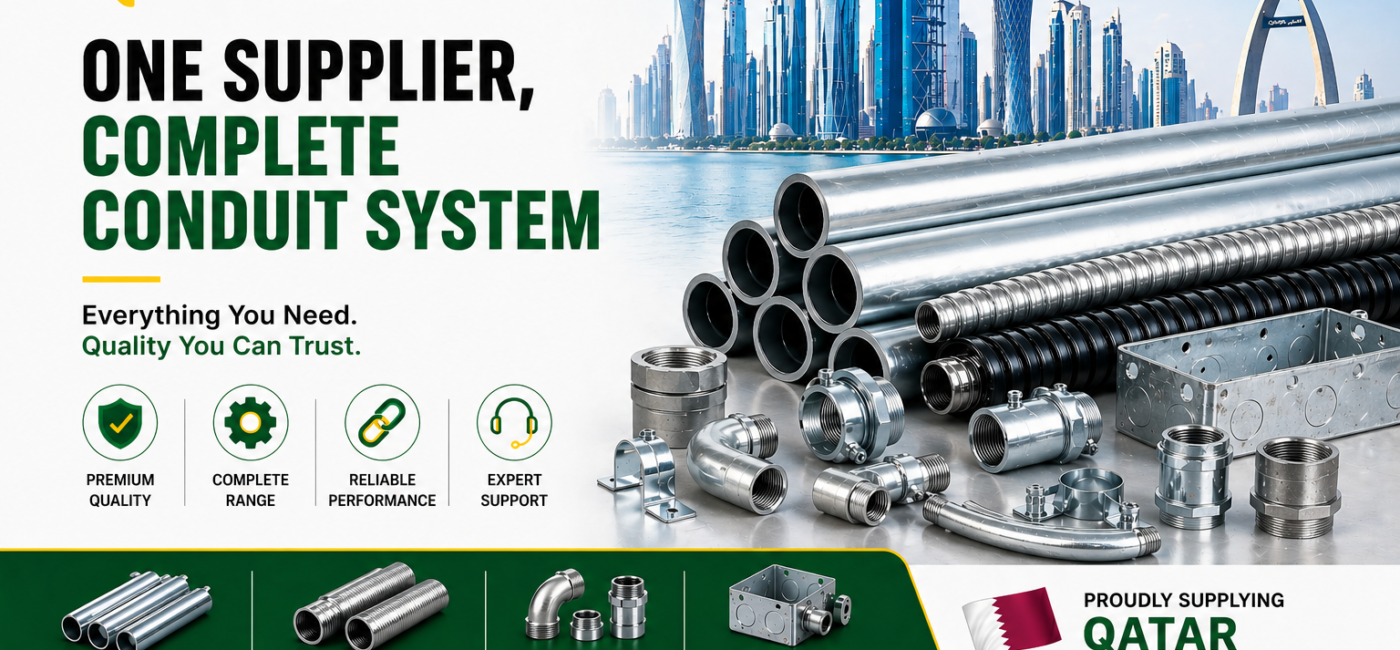
Procurement Guide · 2026
One Supplier, Complete Conduit System: Why Qatar's Procurement Teams Are Done Chasing Multiple Vendors
6 min read · EMT Conduits · GI Conduits · Qatar
Ask any procurement manager on a Qatar electrical project — sourcing the conduit body is never the problem. Sourcing everything that goes with it is where things fall apart.
You order the EMT conduit from one supplier. Couplings from another. Then you're chasing a third vendor for locknuts, a fourth for bushings — and by the time everything lands on site, two weeks are gone and the electricians are standing around waiting. Sound familiar?
It's one of the most common and least talked-about friction points in Qatar's electrical supply chain. And it's entirely avoidable.
Why This Keeps Happening
Qatar's construction sector has grown at a remarkable pace — commercial towers, infrastructure projects, industrial facilities, and large-scale developments have all accelerated demand for EMT and GI conduits across Doha and beyond. But many local suppliers stock only the conduit body itself, with limited accessories. Others carry accessories in select sizes only. Very few offer a fully matched, complete conduit system ready to go.
The real bottleneck: It's not availability — it's fragmentation. When procurement teams split conduit orders across multiple vendors, the hidden costs in time, spec mismatches, and submittal complications add up fast.
EMT vs GI Conduit — Know What You're Ordering
EMT Conduit
Electrical Metallic Tubing — lightweight, thin-walled, and cost-effective. Widely specified for indoor commercial installations: offices, hotels, retail fit-outs, and commercial buildings across Doha. Easy to work with and quick to install.
GI Conduit
Galvanized Iron — threaded, heavy-duty, and built for tough environments. The preferred choice for industrial facilities, outdoor runs, and anywhere cables face mechanical stress or Qatar's harsh climate and humidity conditions.
A Complete Conduit System — Not Just the Pipe
A conduit is not just the tube. Every installation requires a full set of matched accessories to work correctly. When even one piece is missing or mismatched, it creates real problems on site — and delays that ripple through the whole project schedule.
- Couplings — join conduit lengths end to end
- Connectors — terminate into panels & enclosures
- Locknuts — secure connectors at junction points
- Bushings — protect cable insulation at ends
- Bends & Elbows — for directional changes
- Saddles & Clamps — fix conduit runs to surfaces
- Junction Boxes — access and branching points
- Conduit Bodies — pulling and inspection access
Thread tolerances vary between manufacturers. Galvanizing thickness varies. Products that look compatible on paper can behave very differently in a combined installation — and a consultant's material submittal rejection over unmatched accessories is a costly delay no project team wants to deal with.
The Real Cost of Splitting Your Conduit Order
| Factor |
Multiple Vendors |
Single Supplier |
| Time |
4 quotes, 4 delivery timelines |
One order, one delivery |
| Spec Consistency |
Thread & grade mismatches risk |
Fully matched, approved system |
| Submittal Review |
3 manufacturers in one package |
Clean, single-source submittal |
| Site Logistics |
Multiple receipts & coordination |
Streamlined receiving & storage |
What Smart Conduit Procurement Looks Like in Qatar
The projects that run smoothly on the electrical side share one habit: the procurement team decided early to source conduit systems completely — body and accessories together — not piecemeal. Here's what that looks like in practice:
-
1
Specify EMT and GI conduit alongside all accessories in the same BOQ line items — never list them separately across different sections of the document.
-
2
Confirm local stock availability before the project mobilizes — not after the electricians are on site asking where the couplings are.
-
3
Check that accessories are from the same approved product range as the conduit body — matching specs, matching certifications, same manufacturer where possible.
-
4
Prioritize suppliers with internationally approved, certified products — it makes consultant submittal review significantly faster and avoids rejection delays.
-
5
Ask about after-sales support — reliable suppliers stand behind what they sell. If something doesn't perform as expected, you want a clear point of contact and recourse.
The Bottom Line
EMT and GI conduits are foundational to every electrical installation in Qatar — from commercial fit-outs in Lusail to industrial projects across the country. They don't get much attention in planning meetings until something goes wrong. When fittings don't match, accessories are missing, or deliveries arrive scattered from five different vendors, it creates friction that ripples across the entire project.
Qatar's procurement teams are getting smarter about this. The shift from "find the cheapest conduit" to "find a complete, locally available, certified conduit system" is a small mindset change — but it shows up clearly in how smoothly projects actually deliver. That's where the real efficiency lives.
Frequently Asked Questions
What is the difference between EMT conduit and GI conduit?
EMT (Electrical Metallic Tubing) is a lightweight, thin-walled conduit used mainly for indoor commercial and residential electrical installations. It is easy to cut, bend, and install — ideal for offices, hotels, and retail spaces in Qatar. GI (Galvanized Iron) conduit is heavier, threaded, and designed for demanding environments including outdoor installations, industrial facilities, and areas exposed to mechanical impact or harsh weather. The right choice depends on your project type, environment, and consultant specification.
Are EMT and GI conduits suitable for Qatar's climate?
Yes — both are used extensively across Qatar's construction sector. GI conduit is particularly well-suited to Qatar's high temperatures and humidity due to its galvanized coating, which provides strong corrosion resistance. For outdoor or exposed installations, GI is the recommended choice. EMT is typically used in climate-controlled indoor environments. Always confirm your specification with your MEP consultant before selecting.
What accessories do I need with EMT or GI conduit?
A complete conduit system requires more than just the pipe. You will need: couplings (to join lengths end to end), connectors (to terminate into panels and enclosures), locknuts and bushings (to secure and protect at junction points), bends and elbows (for directional changes), saddles and clamps (for fixing to walls and ceilings), and junction boxes or conduit bodies (for access and cable pulling). Sourcing all accessories from the same approved product range as your conduit body ensures consistent specs and avoids installation problems on site.
Do EMT and GI conduits need to be KAHRAMAA approved for Qatar projects?
For projects connected to Qatar's power grid and subject to KAHRAMAA regulations, electrical materials including conduits and accessories must meet the required standards. Consultants will typically specify the required approvals in the project documentation. Using internationally approved, certified products makes the material submittal process significantly smoother and reduces the risk of rejection during consultant review. Verify approval requirements with your project engineer early in the procurement process.
Can I use EMT conduit for outdoor electrical installations in Qatar?
EMT conduit is generally not recommended for outdoor or exposed installations in Qatar. Its thin wall and lighter protection make it vulnerable to corrosion in humid or wet environments. For outdoor runs, exposed conduit on building exteriors, or underground installations, GI (Galvanized Iron) conduit is the correct choice. Always refer to your project specification and consult your MEP engineer before finalising the conduit type for any outdoor application.
What sizes of EMT and GI conduit are commonly available in Qatar?
EMT & GI Conduits in Qatar
are typically available in trade sizes ranging from ½ inch to 4 inches, covering the majority of commercial and industrial installation requirements. Commonly stocked sizes include ½", ¾", 1", 1¼", 1½", and 2". Larger sizes may require advance ordering depending on project volume. Always confirm size availability with your supplier before finalising your BOQ to avoid project delays.
How do I prepare a material submittal for conduit systems in Qatar?
A conduit material submittal package for Qatar projects typically includes: product datasheets for both the conduit body and all accessories, manufacturer certifications and international approvals, compliance statements with the relevant project standards, and where required, test reports. Sourcing your EMT or GI conduit and accessories from a single supplier with a complete, certified product range simplifies this significantly — you present one consistent product family rather than assembling documents from multiple manufacturers.
How quickly can EMT and GI conduits be delivered for projects in Qatar?
Delivery timelines depend on the supplier's local stock levels and your order volume. Suppliers who maintain local inventory in Qatar can typically fulfil standard conduit orders significantly faster than those who import on demand. For large project requirements or specific sizes, confirm availability and lead times with your supplier at the start of the procurement process — ideally before the project mobilises — to avoid site delays.