
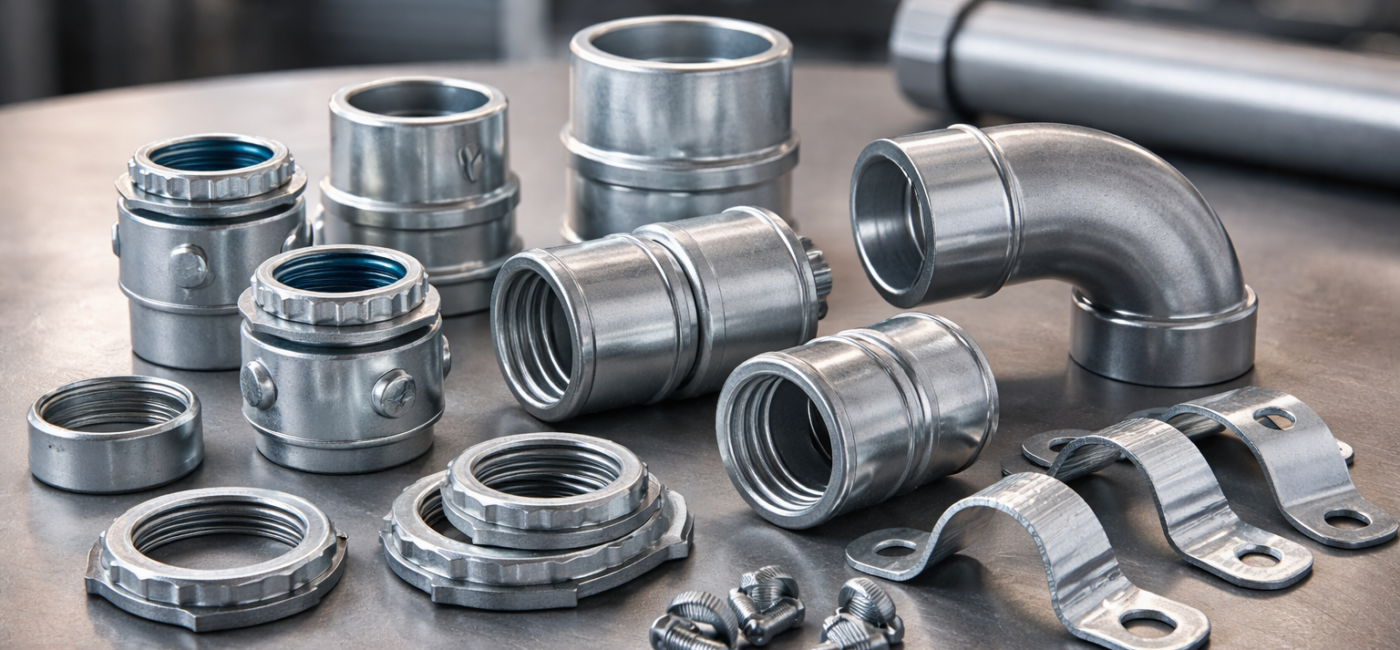
If you’ve been handling electrical installations in Qatar for a while, you already understand how important planning and material readiness are.
On most sites, the real challenge is not installing conduits—it’s keeping the work moving without interruptions. And more often than not, delays happen because small but essential items are missing at the wrong time.
That’s where EMT accessories come in.
After understanding how conduit systems handle load and mechanical stress, the next practical step is making sure every connection, joint, and support point is properly handled. Because in real-world conditions, the strength of your installation depends just as much on the fittings as it does on the conduits themselves.
In Qatar’s construction environment—fast-paced, high-temperature, and often unpredictable—having the right accessories in stock is not optional. It’s part of doing the job right.
Why EMT Accessories Make a Big Difference on Site
On drawings, accessories may look like minor components.
But on site, they directly affect:
- Installation speed
- System stability
- Long-term reliability
- Overall finish quality
When temperatures rise above 45°C, materials expand. When humidity increases, corrosion risk goes up. And when deadlines are tight, there’s no time to fix avoidable mistakes.
This is why experienced contractors don’t just focus on conduits—they focus on the complete system.
A well-installed EMT conduit Qatar system is not just about running pipes. It’s about ensuring every connection is secure, every support is correctly placed, and every cable is properly protected.
Top 7 Essential EMT Accessories Every Contractor Should Stock
Let’s go through the key accessories that should always be available on your site or in your warehouse.
1. EMT Connectors
Connectors are used to attach conduits to electrical boxes, panels, and enclosures. This is one of the most frequently used fittings in any project.
On most sites, you will come across two main types:
- Set-screw connectors for quick indoor installations
- Compression connectors for stronger and tighter connections
In Qatar, compression connectors are often preferred in areas where moisture or vibration is present. They provide a more secure grip and reduce the chances of loosening over time.
From a practical perspective, connectors are used at almost every termination point. Running out of them can stop work immediately.
2. EMT Couplings
Couplings are used to connect one conduit to another, extending the run.
They may seem simple, but they are one of the most used items on site.
In large commercial or infrastructure projects, conduit runs can be long. This means couplings are used continuously throughout the installation process.
A common mistake contractors make is underestimating the quantity required. In reality, you will always need more than expected.
Keeping extra couplings in stock is one of the easiest ways to avoid unnecessary delays.
3. Saddles (Conduit Supports)
Saddles are used to secure conduits to walls, ceilings, or structural supports.
They play a major role in keeping the system stable and properly aligned.
There are typically two types used on site:
- One-hole saddles for quick fixing
- Two-hole saddles for stronger support
In Qatar’s high temperatures, unsupported conduits can expand and start to sag. Over time, this affects alignment and puts stress on connections.
Proper use of saddles ensures that the conduit system remains straight, secure, and professionally installed.
4. EMT Elbows
Direction changes are part of every electrical installation.
While manual bending is possible, it is not always practical—especially on large projects.
Factory-made elbows offer a more consistent and reliable solution.
They help:
- Save installation time
- Maintain uniform bends
- Reduce the risk of conduit damage
In projects where appearance and precision matter, such as commercial buildings in Doha or Lusail, elbows help maintain a clean and uniform look.
They also reduce stress on the conduit, which improves overall system performance.
5. Bushings
Bushings are one of the most important safety components in any conduit system.
They are installed at the ends of conduits to protect cables from sharp edges.
Without bushings, cable insulation can get damaged during installation or over time. This can lead to electrical faults or safety risks.
Even though they are small and inexpensive, bushings should never be ignored.
On well-managed sites in Qatar, proper cable protection is always a priority—and bushings are a key part of that.
6. Locknuts
Locknuts are used together with connectors to secure them firmly to electrical boxes.
They ensure that connections remain tight and do not loosen over time.
In environments where vibration is present, such as industrial facilities, this becomes even more important.
One practical issue on site is that locknuts are easy to lose. They are small, often dropped, and difficult to find again—especially in dusty conditions.
Keeping spare locknuts available can save time and avoid frustration during installation.
7. Pull Elbows (Inspection Elbows)
Pull elbows are used when space is limited or when cables need to be routed through tight areas.
Unlike standard elbows, they have a removable cover that allows access to the inside.
This makes cable pulling much easier, especially in complex layouts.
They are commonly used in:
- Basement installations
- Service corridors
- Areas with multiple systems
In many Qatar projects, where space is shared between electrical, HVAC, and plumbing systems, pull elbows provide the flexibility needed to complete installations efficiently.
How These Accessories Work Together in Real Installations
On site, everything works as a system.
You don’t use these accessories separately—you use them together to build a complete conduit network.
For example:
- Couplings connect conduit lengths
- Connectors attach them to boxes
- Locknuts secure those connections
- Saddles hold everything in place
- Elbows guide direction changes
- Bushings protect the cables inside
When all these components are used correctly, the result is a system that is:
- Strong
- Stable
- Safe
- Long-lasting
If even one of these elements is missing or poorly installed, the entire system can be affected.
Stock Management Tips That Actually Work
Managing EMT accessories properly can make a big difference in project performance.
Here are some practical tips based on real site experience:
- Always keep extra stock of frequently used items
- Focus on commonly used sizes like 20mm and 25mm
- Store materials in a dry and organized space
- Track usage across different projects
- Avoid relying on last-minute purchases
In Qatar, where project timelines are tight, material delays can quickly affect progress.
Good stock management keeps your team working without interruptions.
Common Mistakes Contractors Should Avoid
Even experienced contractors run into these issues:
Underestimating quantities
Small items like couplings and locknuts run out quickly.
Using low-quality fittings
Cheap materials don’t last in Qatar’s environment.
Mixing incompatible sizes
Metric and imperial mismatches can cause poor fittings.
Skipping small components
Ignoring items like bushings leads to bigger problems later.
Poor installation practices
Over-tightening or improper fixing can damage components.
Avoiding these mistakes helps ensure smooth and reliable installations.
Conclusion
In Qatar’s construction industry, success often comes down to preparation.
You can have the best team and the best EMT GI Conduits, but if the accessories are missing or not handled properly, the system won’t perform as expected.
The reality on site is simple:
It’s the connectors that hold things together.
It’s the saddles that keep everything aligned.
It’s the bushings that protect your cables.
And it’s your planning that keeps the project moving.
By keeping these essential EMT accessories in stock and using them correctly, you make your installations stronger, safer, and more reliable.
And in a market like Qatar, that’s exactly what sets good contractors apart from the rest.
Frequently Asked Questions (FAQs)
1. What are the most important EMT accessories to keep in stock in Qatar?
The most important EMT accessories include connectors, couplings, saddles (straps), elbows, bushings, locknuts, and pull elbows. These are used in almost every installation, so running out of them can delay your project. Contractors in Qatar usually keep extra stock of connectors and couplings because they are used the most.
2. Why are EMT accessories important for electrical installations?
EMT accessories are essential because they connect, secure, and support the conduit system. Without them, the installation cannot function properly. They also play a key role in protecting cables, maintaining alignment, and ensuring the system remains stable under heat and environmental stress.
3. Which type of EMT connectors are better for Qatar conditions?
Compression connectors are generally better for Qatar’s environment, especially in areas with humidity or vibration. They provide a tighter and more secure connection compared to set-screw connectors, which are more suitable for dry indoor applications.
4. How do EMT accessories affect the performance of EMT GI conduits?
EMT accessories directly impact the overall performance of EMT GI Conduits. Proper fittings ensure strong connections, reduce stress on the conduit, and prevent issues like sagging or loosening. They also help maintain mechanical strength and protect the wiring inside.
5. How often should EMT conduit supports (saddles) be installed?
In most commercial projects, saddles are installed every 1.5 to 2 meters. Proper spacing is important to prevent sagging and maintain alignment, especially in Qatar’s high-temperature conditions where metal expansion can occur.
6. What happens if bushings are not used in EMT conduit systems?
If bushings are not used, the sharp edges of the conduit can damage the insulation of electrical wires. This can lead to short circuits, electrical faults, or safety hazards. That’s why bushings are considered a must-have in all professional installations.
7. How can contractors avoid delays due to missing EMT accessories?
Contractors can avoid delays by:
- Keeping at least 20% extra stock of frequently used accessories
- Focusing on standard sizes like 20mm and 25mm
- Tracking usage across projects
- Working with reliable suppliers
Proper planning and stock management are key to keeping projects on schedule in Qatar.
8. Are EMT GI conduits suitable for outdoor use in Qatar?
Yes, EMT GI conduits can be used in certain outdoor or semi-exposed areas if they are properly protected and installed with the right accessories. However, for fully exposed environments, additional protection or alternative conduit types may be required depending on project specifications.
9. What is the most common mistake contractors make with EMT accessories?
One of the most common mistakes is underestimating the quantity of accessories needed. Other mistakes include using low-quality fittings, mixing incompatible sizes, and skipping small but important components like bushings and locknuts.
10. How do I choose the right EMT accessories supplier in Qatar?
Look for suppliers who:
- Provide high-quality, certified products
- Understand local project requirements
- Maintain consistent stock availability
- Offer a full range of EMT conduit and accessories
Choosing the right supplier ensures better quality and fewer project delays.