
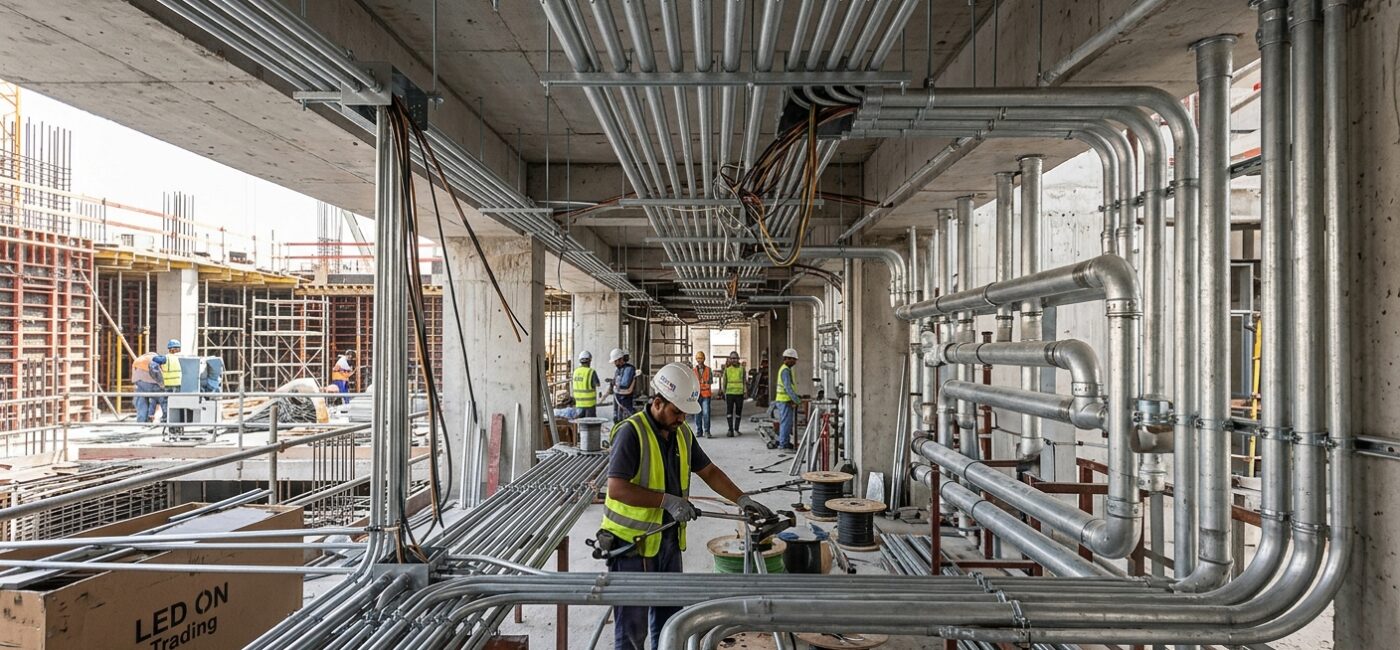

How Conduit Systems Protect Electrical Installations and Support Long-Term Reliability
Electrical cables do the obvious work in any installation — carrying power and signal from the panel to the point of use. But how long a cable performs the way it should depends heavily on what surrounds it. Wiring that's routed and protected properly tends to stay reliable for years. Wiring that's left exposed to impact, abrasion, dust, moisture or vibration tends to develop problems long before the cable itself would otherwise wear out.
This is where conduit systems come in. A properly selected conduit acts as a primary physical protection system for electrical wiring, shielding it from mechanical impact, abrasion, dust, moisture where the system is suitable for that exposure, general environmental stress, accidental contact, vibration and movement, and the kind of incidental damage that happens during and after installation. On commercial fit-outs, industrial facilities and infrastructure projects across Qatar, conduit is one of the main tools available for keeping wiring protected through years of active use, temperature swings and site conditions.
For contractors, MEP consultants, procurement teams and facility managers, understanding what a conduit system actually does — and how EMT and GI conduits differ — makes it easier to specify the right protection for a given project rather than treating conduit as a routine line item.
Why Electrical Wiring Needs More Than Cable Insulation
Cable insulation is designed to contain and protect conductors under normal operating conditions. It is not designed to withstand ongoing mechanical impact, sharp edges, sustained abrasion or the kind of physical stress that's common on active construction sites and in working industrial environments. Once wiring is installed, it can be exposed to a range of risks that insulation alone doesn't address:
- Mechanical damage from tools, equipment or general site activity
- Impact in high-traffic or maintenance-adjacent areas
- Abrasion against rough surfaces or sharp edges
- Excessive bending that stresses conductors over time
- Dust and sand ingress, particularly relevant in Qatar's environment
- Moisture exposure in humid or partially exposed locations
- Heat buildup in densely routed or poorly ventilated spaces
- Vibration from nearby equipment or building movement
- Damage during later construction or maintenance work on adjacent systems
A conduit system addresses this by giving wiring a controlled, protected route rather than leaving it exposed to whatever the surrounding environment throws at it. Conduit isn't simply a pipe that cable happens to run through — it's a deliberate part of the installation's protection and routing strategy, planned alongside the cable specification rather than as an afterthought to it.
What a Conduit System Does for an Electrical Installation
A conduit system performs several distinct functions at once, and understanding each of them helps explain why conduit selection and installation quality both matter.
Physical protection
Conduit shields wiring from mechanical damage and accidental contact — the most direct and immediate benefit it provides, particularly in areas where cables would otherwise be exposed to impact or contact from equipment, tools or foot traffic.
Organized cable routing
Rather than wiring running loosely through voids and cavities, conduit creates a defined, manageable route. This keeps installations legible and predictable, which matters both for safety inspections and for anyone who has to trace or work on the system later.
Cable protection during installation
Conduit protects wiring during the pulling process itself, reducing the risk of abrasion, insulation damage from sharp edges, and stress from tight or improperly finished routes. Well-installed conduit with properly reamed ends and correct bushings makes the installation phase itself considerably safer for the cable.
Environmental protection
The degree of environmental protection depends on the conduit type selected, the fittings used, how well joints are made up, and the overall enclosure design. A well-specified and properly assembled conduit system provides meaningful protection against dust, moisture and general environmental exposure appropriate to the conduit type.
Easier maintenance and cable replacement
Organized conduit routes make inspection, troubleshooting and future cable work considerably more straightforward. When a fault needs tracing or a cable needs replacing, a properly routed conduit system saves significant time compared to wiring that was never given a defined path.
Better long-term installation management
A properly designed conduit system supports the building's electrical infrastructure well beyond the day of installation, making future modifications, additions and upgrades more manageable rather than requiring disruptive rework.
EMT Conduits in Qatar: Lightweight Protection for Suitable Applications
EMT (Electrical Metallic Tubing) is a thin-wall steel conduit valued for being lightweight and relatively straightforward to install compared to heavier conduit types. That combination makes it a practical choice for a wide range of indoor commercial applications, and for light industrial applications where project requirements permit it. EMT is frequently used to create clean, organized exposed wiring routes in offices, retail environments and similar commercial fit-outs, and it works well with a full range of EMT-specific fittings designed to complete the system properly.
When correctly selected, sized and installed, EMT provides effective cable protection for the applications it's intended for. It isn't a lesser alternative to heavier conduit types — it's a different tool suited to different conditions, and in the right application it performs exactly as intended.
Getting the most out of an EMT installation comes down to a handful of installation fundamentals:
- Correct sizing for the cable fill being installed
- Proper bending technique that avoids kinking or flattening the tubing
- Correct connectors matched to the conduit size and application
- Correct couplers at every joint, properly seated and tightened
- Appropriate support spacing along the run
- Avoiding excessive or unnecessary bends
- Protecting cable insulation at every entry and termination point
- Keeping conduit fill within appropriate limits for the cable being installed
Get these right, and EMT delivers reliable, long-term cable protection for the applications it's designed for.
GI Conduits in Qatar: Robust Cable Protection for Demanding Applications
GI (Galvanized Iron) conduit is a heavier-duty, galvanized steel product, and it's typically selected where a project calls for stronger mechanical protection or a more robust conduit than thin-wall EMT is intended to provide. The galvanized coating contributes corrosion resistance, though how it performs depends on the specific environment, installation quality and level of ongoing exposure the conduit experiences.
GI conduit is commonly specified for applications such as:
- Industrial facilities with higher mechanical exposure
- Plant rooms and utility areas
- Commercial projects with exposed conduit routing
- Infrastructure projects
- Suitable outdoor applications, depending on the specific specifications and environmental conditions
Selecting GI conduit appropriately means weighing the actual mechanical exposure, corrosion conditions, coastal exposure where relevant, humidity, chemical exposure, temperature, project specifications and applicable standards for that specific installation. GI conduit isn't automatically the superior choice simply because it's heavier — the correct conduit is the one matched to the environment and the project's actual requirements.
EMT vs GI Conduit: Which Is Right for the Project?
Rather than treating this as a question of which conduit is "better," it's more useful to compare the two against the actual demands of a project:
- Construction: EMT is thin-wall steel tubing; GI conduit is heavier-gauge galvanized steel.
- Typical application: EMT suits indoor commercial and appropriate light industrial routing; GI conduit suits applications requiring stronger mechanical protection.
- Mechanical protection: GI conduit generally offers a higher level of mechanical robustness; EMT offers adequate protection for its intended applications.
- Installation characteristics: EMT is lighter and generally faster to install and modify; GI conduit requires more handling but suits more demanding routes.
- Environmental considerations: Both require selection based on the specific exposure conditions rather than a general assumption.
- Weight and handling: EMT is easier to handle on site, particularly for extensive exposed runs; GI conduit's added weight reflects its heavier construction.
- Fitting requirements: Each conduit type uses its own compatible range of connectors, couplers and accessories.
- Project suitability: The right choice depends on the installation environment, mechanical demands and project specification, not a fixed hierarchy between the two.
In practice, many projects use both EMT and GI conduit in different areas, matching each product to the specific demands of that part of the installation.
Why Conduit Accessories Are Critical to the Protection System
A conduit system is only as effective as the complete assembly it forms — conduit, connectors, couplers, elbows, saddles, bushings, locknuts and supports all working together. The conduit itself provides the protective pathway; compatible accessories complete and secure that pathway.
Depending on the conduit type, this includes EMT compression connectors, EMT set-screw connectors, EMT couplers, 90-degree elbows, saddles, benders for forming accurate bends on site, and the equivalent range of GI conduit accessories including connectors, bushings, locknuts and supports. Each of these plays a specific role in the finished system:
- Mechanical integrity — secure connections at every joint keep the run stable under normal building movement and vibration
- Correct alignment — elbows and bends maintain proper routing through direction changes without stressing the conduit or cable
- Secure connections — connectors and couplers matched to the conduit size seat properly and stay tight over time
- Cable protection — bushings and correctly fitted terminations protect insulation at every entry point
- Proper transitions — compatible fittings ensure clean transitions between conduit sections and enclosures
- Stable routing — saddles and supports keep runs fixed in place at appropriate intervals
- Grounding continuity — where applicable, properly made connections support the continuity of the system
Sourcing conduit and accessories as a matched, compatible range makes a meaningful difference to how well the finished system performs as a whole.
How Poor Conduit Installation Can Reduce Cable Protection
Conduit systems are highly effective when installed correctly. Most issues that arise trace back to a small number of avoidable installation mistakes rather than any shortcoming in the conduit itself.
Incorrect conduit sizing
Undersized conduit leads to overcrowding, making cable pulling more difficult and future additions harder to accommodate. Correct sizing from the outset prevents this entirely.
Excessive bends
More bends than necessary increase pulling tension and complicate future cable replacement. Planning routes with the minimum practical number of bends keeps the system easier to work with long-term.
Poor support
Inadequately supported conduit can sag or shift over time, placing stress on joints and cables. Correct support spacing keeps the run stable for the life of the installation.
Damaged or deformed conduit
Dented or kinked sections should be replaced rather than installed, since damage can restrict interior space and create sharp points. Using undamaged conduit preserves the protection the product is designed to offer.
Incorrect fittings
Mismatched or loose connectors undermine both the mechanical strength of the run and, where applicable, grounding continuity. Using fittings matched to the conduit type and size avoids this.
Sharp or unprotected edges
Cut ends and box entries need to be properly reamed and fitted with bushings to protect cable insulation from ongoing abrasion. This is a simple step that preserves the cable protection conduit is meant to provide.
Incorrect environmental selection
Choosing conduit and accessories without accounting for the actual environment can lead to underperformance. Matching the product to the conditions ensures the protection holds up as intended.
Poor routing
Routes that ignore accessibility or future maintenance make the system harder to work with later, even if the initial installation looks fine. Thoughtful routing keeps the system practical for years to come.
Inadequate maintenance
Visible corrosion, loose supports or compromised fittings should be addressed as soon as they're noticed. Routine attention keeps the protection system performing as designed.
Qatar's Climate and Electrical Cable Protection
Qatar's operating conditions add real weight to conduit selection. High ambient temperatures, humidity, dust and sand exposure, coastal conditions in relevant areas, demanding industrial environments, and active construction-site exposure all affect how wiring systems perform over time. These conditions are exactly why appropriate cable protection matters across commercial, industrial and infrastructure projects in Qatar — a properly selected conduit system gives wiring a meaningful buffer against them.
Material selection and installation practices should always follow the applicable project specifications and relevant electrical standards for the specific conditions a project will face, rather than a generic, one-size-fits-all approach.
How to Choose the Right Electrical Conduit System
A practical selection process starts with the installation conditions and works toward the right product, covering:
- Installation location — indoor, outdoor or transitional
- Mechanical exposure specific to that location
- Moisture and humidity conditions
- Ambient and operating temperature
- Corrosion risk from the surrounding environment
- Cable quantity and required conduit fill
- Conduit size matched to the cable being installed
- Cable bend radius requirements
- Routing complexity and overall run length
- Fittings required to complete the system properly
- Future maintenance and access needs
- Project specifications and applicable electrical standards
Working through these factors before specifying a product keeps the final selection matched to how the installation will actually be used.
Why Correct Conduit Sizing Matters
Conduit sizing directly affects how well the finished system performs. Correct sizing keeps cable fill at a manageable level, which makes pulling easier during installation, helps manage heat within the conduit, and leaves reasonable room for future maintenance or cable replacement. Undersized conduit creates the opposite problem on every one of these points — harder pulling, tighter fill, and a system that's more difficult to work on later. Sizing should always be based on the actual cables being installed and the applicable project requirements rather than approximated after the fact.
Designing Conduit Routes for Long-Term Maintenance
A conduit system earns its value over the full life of the installation, not just on handover day. Designing routes with maintenance in mind means keeping runs reasonably accessible, using logical routing that's easy to trace, identifying conduit clearly in plant rooms and service areas, allowing enough access for inspection, planning for eventual cable replacement, and leaving sensible capacity for future expansion where the project allows for it. Minimizing unnecessary bends throughout the route also keeps future cable work more straightforward. Good conduit planning at the design stage can significantly reduce the disruption involved when wiring eventually needs attention.
Choosing EMT GI Conduits & Accessories in Qatar
For contractors, MEP teams and procurement professionals sourcing EMT GI conduits & accessories in Qatar, working with a supplier that carries a complete, compatible range makes it far easier to specify a coherent protection system rather than piecing one together from multiple sources.
LED ON Trading's range covers EMT conduit in commonly used sizes, EMT compression connectors and couplers, EMT set-screw connectors and couplers, 90-degree elbows, saddles, EMT benders, and GI conduit in standard sizes. Having these available from a single supplier helps contractors match conduit and accessories correctly from the outset, rather than sourcing fittings separately and risking compatibility issues on site.
The wider electrical products range covers related materials that often come up on the same projects, and the full catalogue can be browsed through the shop. For any project team working on commercial, industrial or infrastructure work in Qatar, sourcing conduit and accessories as a matched system is one of the more practical ways to get consistent, reliable cable protection across the installation.
Practical Checklist for a Reliable Conduit Installation
- Select conduit based on the actual application and environment.
- Choose the appropriate conduit size for the cable fill required.
- Plan routes before installation begins.
- Minimize unnecessary bends wherever the layout allows.
- Use fittings and accessories compatible with the conduit being installed.
- Protect cable insulation at entries, terminations and transitions.
- Support conduit correctly and at appropriate intervals.
- Check joints and connections for a proper, secure fit.
- Inspect for physical or environmental damage before and after installation.
- Follow project specifications and applicable requirements throughout.
Final Thoughts
A reliable electrical installation depends on quality wiring and appropriate protection working together. A properly selected and installed conduit system provides a physical pathway and protective barrier that safeguards cables, supports easier maintenance, and contributes directly to the long-term reliability of the installation. EMT and GI conduits each serve applications suited to their construction, and compatible accessories complete the protection system rather than sitting alongside it as an extra.
For contractors, MEP consultants and procurement teams working across Qatar, LED ON Trading supplies EMT and GI conduits and a matched range of accessories to suit different project requirements, available through the LED ON Trading website.
Frequently Asked Questions
How do conduit systems protect electrical wiring?
Conduit systems create a controlled, protected route for electrical wiring, shielding it from mechanical impact, abrasion, dust, moisture and other environmental exposure depending on the conduit type. Combined with correctly fitted accessories, conduit forms a complete protective pathway around the cable rather than leaving it exposed.
What is the difference between EMT and GI conduit?
EMT is a lightweight, thin-wall steel conduit suited to indoor commercial and appropriate light industrial routing, while GI conduit is a heavier-gauge galvanized product typically selected where stronger mechanical protection is needed. Both provide effective cable protection when matched correctly to the application.
Are EMT conduits suitable for commercial electrical installations?
Yes. EMT is widely used across commercial installations in Qatar for organized, exposed wiring routes, and it provides effective cable protection when correctly sized, supported and fitted with compatible connectors and couplers.
When should GI conduit be considered?
GI conduit is typically considered where a project requires stronger mechanical protection, such as industrial facilities, plant rooms, utility areas or exposed commercial routing, and should be selected based on the specific mechanical, environmental and project requirements involved.
Why are conduit fittings and accessories important?
Fittings and accessories complete the conduit system, holding joints together mechanically, maintaining correct alignment, protecting cable insulation at entries, and supporting stable, secure routing throughout the installation. A conduit run is only as effective as the connections that make it up.
How should electrical conduit be selected in Qatar?
Selection should account for Qatar's high temperatures, humidity, dust and sand exposure, coastal conditions where relevant, and construction-site conditions, alongside the applicable project specifications and electrical standards for that specific installation.
Does conduit help extend the service life of electrical installations?
A properly selected and installed conduit system provides meaningful physical and environmental protection that supports the long-term reliability of electrical wiring, working alongside cable quality, correct loading and regular maintenance as part of a durable overall installation.
Where can contractors find EMT and GI conduits and accessories in Qatar?
LED ON Trading supplies EMT GI conduits & accessories in Qatar, including conduit in common sizes along with compatible connectors, couplers, elbows, saddles and benders, available through the company's online shop.