
Why Two Batteries with the Same Capacity Can Deliver Very Different Results
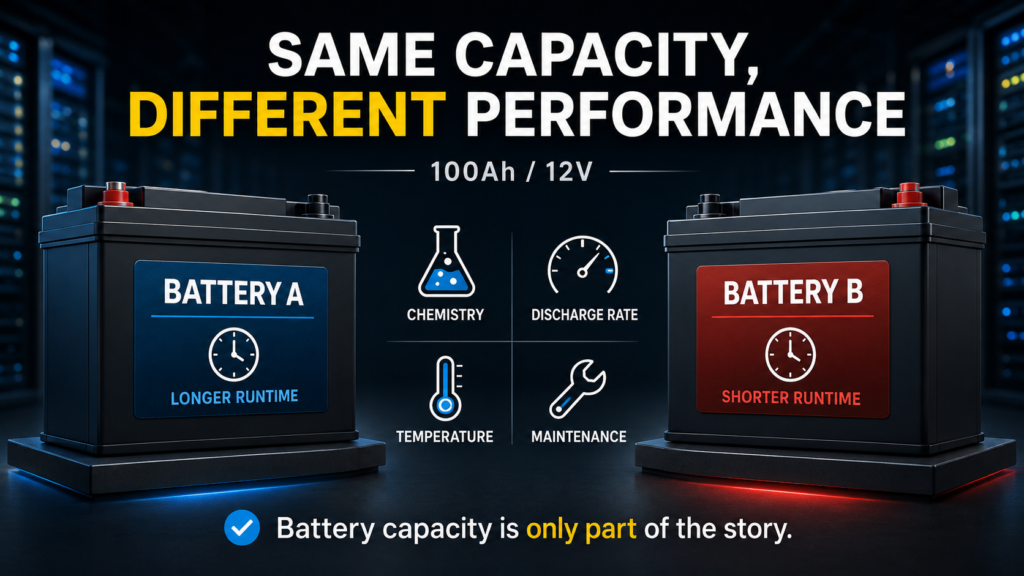
A facility manager replaces an aging UPS battery with a new model carrying exactly the same Battery Capacity rating. The voltage, amp-hour rating, and physical size all match. Yet during the next power interruption, the new battery provides noticeably less backup time.
This situation is more common than many businesses expect.
Battery Capacity is an important specification, but it does not fully determine Battery Runtime, efficiency, reliability, or service life. Battery chemistry, manufacturing quality, discharge rate, temperature, age, charging practices, and maintenance all influence real-world Battery Performance.
Understanding these factors helps businesses select batteries based on application requirements rather than relying only on the Ah number printed on the label.
Why Battery Capacity Does Not Tell the Whole Story
Battery Capacity is normally measured in amp-hours, or Ah. A 100 Ah battery can theoretically provide 5 amps for 20 hours under specified testing conditions.
However, that does not mean it will provide the same result in every application.
Watt-hours give a broader indication of stored energy because they consider both voltage and capacity:
Watt-hours = Voltage × Amp-hours
A 12 V, 100 Ah battery contains approximately 1,200 Wh of nominal energy. In practice, the connected equipment may not be able to use all of it. Voltage drop, inverter losses, cable resistance, temperature, and equipment cut-off settings reduce the usable energy.
Think of two vehicles with the same fuel-tank size. One has an efficient engine and carries a light load. The other has an inefficient engine and carries heavy cargo. Both have the same tank capacity, but they will not travel the same distance.
Batteries behave in a similar way. Battery Capacity describes the size of the energy tank, while actual Battery Performance depends on how efficiently that energy is delivered.
Seven Reasons Batteries with the Same Capacity Perform Differently
1. Battery Chemistry
Different battery chemistries deliver energy in different ways.
Lead Acid Batteries remain widely used in UPS, telecom, industrial, and emergency power applications. AGM and gel batteries are sealed lead-acid designs, while flooded batteries require regular inspection and electrolyte maintenance.
Lithium batteries usually maintain voltage more steadily during discharge and may offer faster charging, higher efficiency, and a greater usable depth of discharge.
| Battery type | Main advantage | Main consideration |
|---|---|---|
| Flooded lead acid | Proven and suitable for large systems | Requires ventilation and maintenance |
| AGM | Strong current delivery and low maintenance | Sensitive to heat and incorrect charging |
| Gel | Suitable for selected deep-cycle applications | Requires controlled charging voltage |
| Lithium | High efficiency and stable voltage | Requires compatible protection and battery management |
Two batteries with the same Battery Capacity may therefore provide different runtime because their voltage behaviour, discharge efficiency, and usable energy differ.
2. Manufacturing Quality
Battery labels may look similar even when the internal construction is very different.
In Lead Acid Batteries, plate thickness, grid design, separator quality, active materials, weld strength, electrolyte consistency, and quality-control procedures all influence performance.
Lower-quality batteries may experience:
- Higher internal resistance
- Greater voltage drop
- Uneven charging
- Poor high-current performance
- Faster internal wear
- Premature capacity loss
A battery may show a normal open-circuit voltage but fail quickly when connected to a heavy UPS load. This is why basic voltage testing alone cannot confirm battery health.
Manufacturer reputation, technical documentation, certifications, warranty conditions, and proven performance in similar applications should be reviewed before purchasing Industrial Batteries.
3. Discharge Rate
The rate at which energy is drawn affects usable Battery Capacity.
Lead-acid batteries normally provide less usable energy when discharged at high current. This behaviour is commonly explained by Peukert’s Law.
The principle is simple: the faster a lead-acid battery is discharged, the sooner its voltage falls to the equipment’s cut-off point.
For example, a battery may provide several hours of runtime when supporting a small office load. The same battery may provide only a short backup period when connected to a heavily loaded UPS.
UPS Batteries should therefore be compared using manufacturer discharge tables at the required load and runtime.
Battery sizing should consider:
- Actual connected load
- Required backup duration
- Inverter efficiency
- Maximum discharge current
- Future load expansion
- Battery aging
- End-of-discharge voltage
- Operating temperature
Dividing Ah by load current may provide a rough estimate, but it is not reliable for critical power systems.
4. Operating Temperature
Temperature affects Battery Capacity, charging behaviour, performance, and Battery Life.
Cold temperatures slow the chemical reaction inside the battery. This reduces available capacity and can weaken power delivery.
High temperatures may temporarily improve output, but they accelerate corrosion, water loss, separator damage, and internal aging.
This is especially important in:
- Data centers
- Warehouses
- Outdoor telecom sites
- Industrial plants
- Unconditioned electrical rooms
A battery installed in a temperature-controlled data center may last much longer than the same model installed in a hot outdoor cabinet.
Charging voltage must also match the operating temperature. Without proper temperature compensation, batteries may be undercharged in cold conditions or overcharged in hot environments.
5. Battery Age
Battery Capacity gradually declines with age.
Lead-acid batteries experience sulfation, grid corrosion, active-material loss, and internal wear. Lithium batteries also lose capacity through calendar aging and repeated charge-discharge cycles.
An older battery may still display normal voltage while providing very little runtime under load.
Battery condition should therefore be assessed using methods such as:
- Controlled discharge testing
- Runtime testing
- Conductance testing
- Impedance trending
- Internal resistance measurement
- Temperature monitoring
Mixing old and new batteries in the same string can create imbalance. The weakest battery may limit the output of the complete bank, including the new batteries.
For critical systems, matched batteries with similar manufacturing dates and service history usually provide more predictable results.
6. Charging Practices
Incorrect charging is one of the most common causes of poor Battery Performance.
Undercharging can leave Lead Acid Batteries in a partially charged condition and promote sulfation. Overcharging can create excessive heat, water loss, grid corrosion, swelling, or dry-out.
Stationary systems commonly use float charging to keep batteries ready for an outage. Some flooded battery systems may also require controlled equalization under manufacturer guidance.
AGM, gel, and lithium batteries each require suitable charging profiles.
Charging systems should be checked for:
- Correct float voltage
- Correct boost or equalization settings
- Temperature compensation
- Charger capacity
- Stable charge current
- Battery chemistry compatibility
Two telecom battery banks using the same batteries may have completely different service lives if one rectifier is correctly configured and the other continuously undercharges the bank.
7. Maintenance
Even batteries described as maintenance-free still require inspection and testing.
Preventive battery maintenance should include:
- Inspecting cases for swelling, cracks, or leakage
- Cleaning terminals and checking for corrosion
- Checking charger voltage and settings
- Monitoring battery-room temperature
- Checking connections and torque
- Measuring conductance, impedance, or resistance
- Performing planned capacity or runtime tests
- Investigating batteries that differ from the string average
Loose or corroded connections increase resistance and reduce the power delivered to the load.
Regular maintenance also helps businesses plan battery replacement before failure, reducing unexpected downtime and protecting Business Continuity.
How Battery Capacity Affects Different Industries
Data Centers
Data center UPS batteries often support heavy loads until generators start and stabilize. High-rate discharge capability, temperature control, string balance, and monitoring are often more important than Ah rating alone.
Telecommunications
Telecom batteries may operate in outdoor cabinets exposed to heat and frequent power interruptions. Charging quality, ventilation, repeated cycling, and maintenance access strongly affect service life.
Manufacturing Plants
Industrial loads may include motors, controls, and automated equipment. Sudden load changes, heat, vibration, and dust can affect Industrial Power Backup performance.
Hospitals
Hospitals require predictable emergency power for critical equipment, communication systems, monitoring devices, and safety systems. Batteries must be selected according to the application, required runtime, and risk level.
Airports and Banks
Airports and banks rely on batteries for communication, security, transaction systems, servers, access control, and operational infrastructure. Small increases in connected load can significantly reduce Battery Runtime.
Warehouses and Commercial Buildings
New network equipment, security systems, scanners, automation devices, and building controls are often added without recalculating backup duration. Battery Capacity remains the same, but runtime falls as the connected load increases.
Common Battery Buying Mistakes
Businesses often reduce reliability by:
- Buying only according to Ah rating
- Selecting the lowest-priced battery
- Ignoring manufacturing and storage dates
- Mixing old and new batteries
- Using incorrect charger settings
- Ignoring temperature and ventilation
- Skipping inspections and testing
- Using incorrect battery sizing
These mistakes can result in unexpected shutdowns, data loss, production delays, equipment alarms, service interruption, and emergency replacement costs.
How to Compare Batteries Properly
A proper battery comparison should consider the complete application, not only Battery Capacity.
Review the following:
- Required runtime
- Actual connected load
- Battery chemistry
- Manufacturer discharge curves
- High-rate performance
- Cycle life
- Temperature tolerance
- Charging requirements
- Warranty terms
- Certifications
- Maintenance needs
- Safety requirements
- Manufacturer reputation
- Technical support
- Total cost of ownership
The UPS, charger, inverter, cables, connections, protection settings, ventilation, and monitoring system should also be evaluated.
A high-quality battery cannot provide reliable Backup Power Solutions if it is installed in a poorly designed or incorrectly configured system.
Future Battery Performance Technologies
Smart Battery Monitoring Systems now provide greater visibility into real battery condition.
These systems can monitor:
- Individual battery voltage
- Charge and discharge current
- Temperature
- Internal resistance
- Cell imbalance
- Alarm history
- Charging behaviour
AI-assisted battery diagnostics and predictive maintenance tools can identify unusual performance patterns before a serious failure occurs.
Digital battery management helps businesses estimate remaining life, plan replacements, identify charger problems, and monitor batteries across multiple sites.
Improved Lead Acid Battery technology, advanced lithium systems, stronger recycling programs, and battery analytics are also helping businesses evaluate performance beyond simple capacity ratings.
Final Thoughts on Battery Capacity
Battery Capacity remains an essential specification, but it is only one part of overall performance.
Two batteries with the same Ah rating can provide different runtime, efficiency, service life, and reliability because of differences in chemistry, quality, discharge rate, temperature, age, charging, maintenance, and application.
Businesses should compare batteries according to the real load, required runtime, operating environment, system compatibility, and total cost of ownership.
The best battery is not simply the one with the highest capacity or lowest price. It is the battery that delivers predictable performance throughout its expected service life.