
Looking for the Best
Lead Acid Battery
in Qatar?
Here's what businesses across Doha and Qatar's industrial zones actually prefer — and why Terminator and Bright Cell consistently come out on top.
It's the middle of a sweltering Doha afternoon. Your warehouse operations are running at full speed — and without warning, the grid goes down. Within seconds, your UPS systems kick in. Or at least, they're supposed to. If the batteries powering those systems are worn out or low quality, that moment of silence becomes a very expensive problem.
For businesses across Qatar — from logistics hubs in the Industrial Area to corporate offices along the Corniche — reliable backup power isn't a luxury. It's non-negotiable. And at the heart of every dependable backup power setup sits one critical component: the battery.
This guide answers the question that procurement managers, facility supervisors, and engineers across Qatar keep asking: which lead acid battery can actually handle Qatar's unique demands?
batteries must endure
Why Qatar Businesses Still Prefer Lead Acid Batteries
In an era of lithium-ion buzz, you might wonder why so many commercial and industrial users in Qatar continue to rely on lead acid technology. The answer is straightforward: proven performance, cost-effectiveness, and wide local availability.
Lead acid batteries have powered industrial systems for over a century. That longevity isn't accidental — it's earned through reliability under pressure.
Lower Upfront Cost
Significantly less capital investment versus lithium alternatives — ideal for large UPS banks and multi-site operations.
High Surge Current
Delivers strong current bursts — exactly what UPS systems and industrial equipment need during power transitions.
Established Technology
Electricians and engineers throughout Qatar are deeply familiar with lead acid systems, reducing maintenance complexity.
Heat-Resistant Builds
Quality lead acid batteries are engineered to perform under the extreme heat conditions common across the Gulf region.
Recyclable
Among the most recycled products in the world — a more environmentally responsible choice when handled correctly.
Local Availability
Commercial battery suppliers in Qatar stock lead acid products extensively — rapid replacement when you need it.
Terminator and Bright Cell — The Names Qatar Businesses Trust
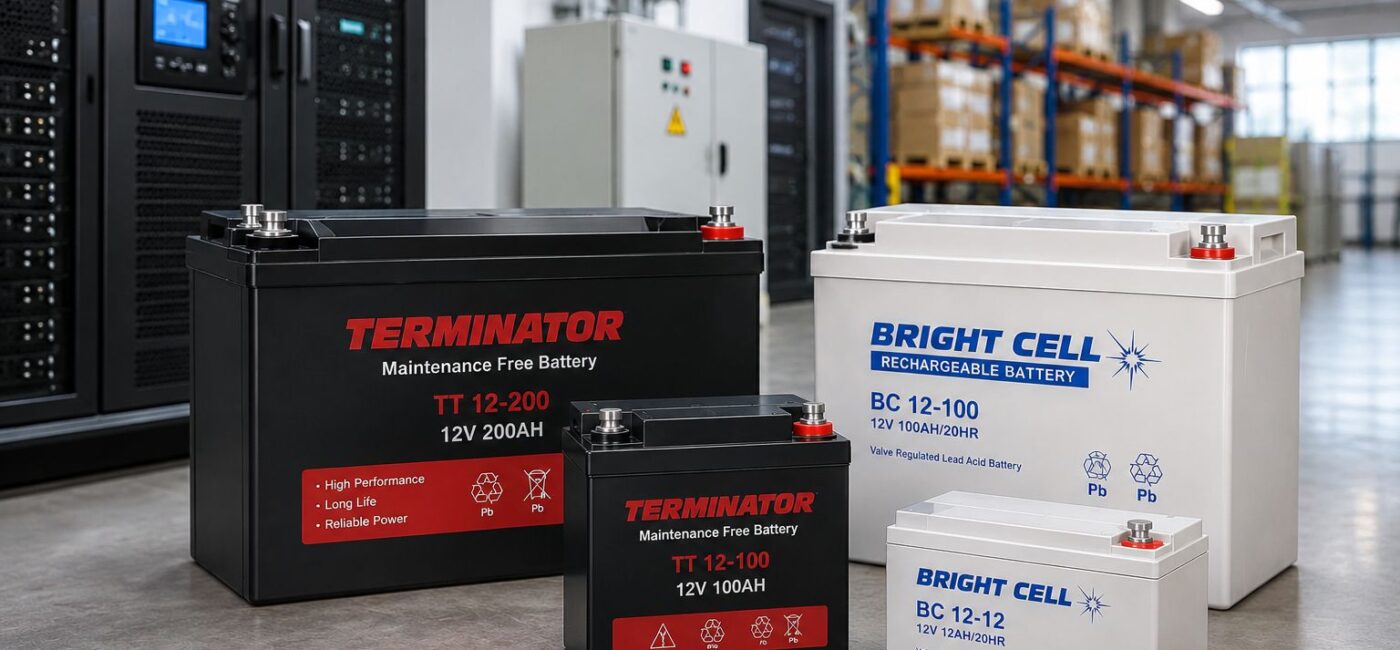
Two brands consistently come up in conversations among Qatar's procurement managers and electrical contractors: Terminator and Bright Cell. Both have built strong reputations in the GCC market for batteries that combine technical reliability with real-world durability.
Terminator
Built for Demanding Environments
- Sealed, maintenance-free design — no water top-ups needed
- Deep cycle capability with minimal capacity loss over time
- Heat-resistant casing engineered for Gulf conditions
- Versatile: UPS, emergency lighting, telecom, solar
- Stable voltage output for sensitive electronics
Bright Cell
Precision-Engineered Power Storage
- Advanced AGM technology — no free liquid, safe in any orientation
- Extended calendar life reduces replacement frequency
- Low self-discharge — stays ready even after long storage
- Wide UPS compatibility across device types
- Excellent charge acceptance — faster recovery after outages
Bright Cell 12V 12Ah — Popular Choice for Commercial UPS
Widely recommended for offices, facilities, and industrial backup across Qatar. In stock, warranted, and ready to ship.

Industrial-grade lead acid batteries powering UPS and backup systems for businesses across Qatar.
How to Choose the Right Battery for Your Setup
Selecting a battery isn't as simple as picking the cheapest option. The wrong choice can lead to premature failure, equipment damage, or a complete backup power blackout during a critical moment.
Match Voltage and Capacity to Your Equipment
Always start with your UPS manufacturer's specifications. Capacity (Ah) determines how long your system can sustain power during an outage. A 12V 12Ah battery suits smaller UPS units; larger systems may need 12V 100Ah or higher.
Understand Your Load Requirements
Calculate the total wattage of equipment you need to support during an outage. Factor in continuous load and peak load during startup. This calculation directly determines the battery bank size you need.
Choose VRLA for Indoor UPS Use
For most UPS backup applications, VRLA (Valve Regulated Lead Acid) batteries — including AGM and gel variants — are the preferred choice. Sealed, maintenance-free, and safe for indoor installation. Both Terminator and Bright Cell offer excellent VRLA options.
Consider the Duty Cycle
How often will your system experience power cuts? In standby mode, most of the battery's life is in float charge. In solar storage or high-interruption areas, deeper cycling is required. Match the battery's cycle rating accordingly.
Verify Heat Tolerance
This point cannot be overstated for Qatar. Ambient temperatures in warehouses and non-climate-controlled rooms can be extreme. Always check the battery's operating temperature range. Batteries rated for high-temperature environments will significantly outperform standard units locally.
Source from Reputable Local Suppliers
With counterfeit batteries circulating in some markets, buying from established commercial battery suppliers in Qatar is essential. Reputable suppliers provide genuine products with warranties, technical datasheets, and after-sales support.
Common Problems from Low-Quality Batteries — Why They Cost More Long-Term
A business opts for the cheapest available battery, only to face recurring failures, equipment damage, and escalating maintenance costs. It's a pattern seen again and again in Qatar's commercial sector.
Premature Capacity Loss
Cheap batteries lose rated capacity much faster, leaving UPS unable to deliver needed runtime.
Swelling & Leakage
Low-grade batteries can swell or leak electrolyte, damaging the UPS unit and creating safety hazards.
Thermal Runaway Risk
In Qatar's heat, inadequate thermal management can trigger dangerous chain reactions — and in severe cases, fire.
Inconsistent Voltage
Unstable voltage from failing batteries can damage servers, medical devices, and industrial control systems.
Frequent Replacement
A battery replaced every 12–18 months costs far more over time than a quality unit lasting 3–5 years.
Unexpected Downtime
A failed battery means zero backup power precisely when your business needs it most.
Why Qatar's Climate Demands More from Your Batteries
Qatar's environment is punishing for many types of electrical equipment. Summer temperatures regularly exceed 45°C outdoors, and even indoor environments — particularly warehouses and non-climate-controlled server rooms — can climb well above comfortable operating ranges.
Key fact: Every 10°C rise in operating temperature above 25°C roughly halves the expected battery lifespan. A battery rated for 5 years at 25°C may last only 18 months at 45°C — a daily operational reality for businesses throughout Qatar.
Here's how to address it:
Commercial Buyer's Checklist Before You Purchase
Whether you're sourcing a single replacement battery or procuring bulk supply for a multi-site operation, these considerations will help you make a confident purchase decision.
Verify Authenticity
Purchase only from authorised distributors. Genuine products come with manufacturer documentation, warranty cards, and consistent labelling.
Request Datasheets
Any reputable supplier provides technical datasheets covering rated capacity, temperature range, charge characteristics, and expected service life.
Understand Warranty
Quality batteries from established brands come with 1–3 year warranties. Understand what's covered and how claims are processed.
Total Cost of Ownership
Factor in service life, replacement frequency, and downtime costs. A QAR 350 battery lasting 5 years beats a QAR 200 battery replaced every 18 months.
Buy the Right Quantity
Replace all batteries in a bank simultaneously and from the same batch. Mixing old and new batteries reduces overall system performance.
Check Local Stock
For critical infrastructure, a trusted local supplier maintaining stock is invaluable. When a battery fails, waiting weeks for imports isn't an option.
Frequently Asked Questions
Don't Let an Unreliable Battery Be Your
Business's Weak Link
Backup power is only as reliable as the battery behind it. In Qatar's fast-moving commercial and industrial landscape, the batteries you choose matter enormously. Invest in proven brands, buy from suppliers who stand behind what they sell, and protect your operations before the next outage strikes.
🔋 Shop Bright Cell Batteries in Qatar