
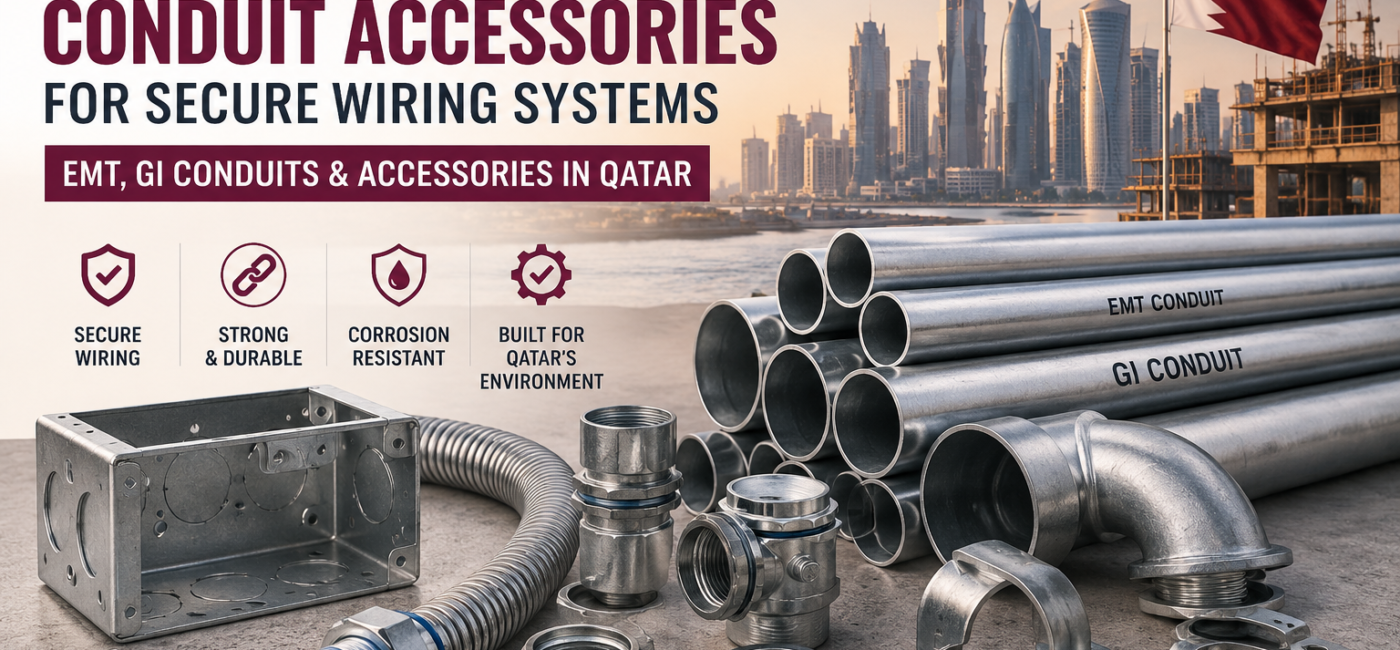
Choosing the Best Conduit Accessories for
Secure Wiring Systems
EMT, GI Conduits & Accessories in Qatar · Updated 2026 · 8 min read
Why Secure Wiring Systems Start with the Right Conduit Accessories
Qatar's construction sector has been growing at a pace that few regions in the world can match. Mega-projects, smart-city developments, and rapid industrial expansion have pushed demand for EMT, GI conduits & accessories in Qatar to an all-time high. Contractors, MEP engineers, and procurement teams are under pressure to source products that perform reliably in extreme conditions — and perform they must, because an electrical fault in this climate is not just expensive; it can be genuinely dangerous.
This guide walks you through everything you need to know about conduit accessories — what they are, which types matter, how to compare EMT vs GI systems, and what to look for before placing your next order.
What Are Conduit Accessories?
At their core, conduit accessories are the hardware components that hold your conduit system together — literally and electrically. They include every fitting, connector, bracket, and junction device that secures the conduit to the structure, joins sections together, and protects cable at every transition point.
Think of electrical conduit accessories as the skeleton of your wiring protection system. The conduit pipe itself is just the tube; the accessories are what make that tube a coherent, sealed, and structurally sound pathway for electrical cables. Without quality fittings, even premium conduit becomes a liability — loose connections introduce moisture, allow cable movement, and create points of mechanical failure.
Types of Conduit Accessories (and When to Use Each)
Not all accessories serve the same function. Here's a practical breakdown of the most important types of conduit connectors and fittings you'll encounter on any commercial or industrial project in Qatar:
Connectors
Join conduit to a box or enclosure. Available in straight, angled, and compression styles for EMT and GI applications.
Couplings
Connect two conduit sections end-to-end. Threaded couplings suit GI; set-screw or compression couplings are common for EMT.
Junction Boxes
House wire junctions, splices, and terminations. Essential in long cable runs and any installation requiring future access.
Saddles & Clamps
Secure conduit to walls, ceilings, or cable trays. Spacing them correctly prevents sagging and vibration damage.
Bends & Elbows
Allow direction changes without kinking. 90°, 45°, and custom-angle bends are available for both EMT and GI.
Locknuts & Bushings
Secure conduit into knockout holes and protect cable insulation from sharp edges at entry points.
Flexible Conduit Fittings
Connect rigid conduit to motors, transformers, or any equipment subject to vibration. Critical in industrial environments.
Why Quality Conduit Accessories Matter More Than You Think
When procurement teams look for ways to trim project costs, conduit fittings are often the first target. This logic is understandable but flawed. Here's why quality should never be compromised when it comes to electrical installation accessories:
- Electrical Safety: Poor-quality connectors can loosen over time, creating arcing hazards and potential fire risks — particularly dangerous in Qatar's high-temperature environments.
- Corrosion Resistance: Gulf humidity and salt-laden air are harsh on metals. Premium GI conduit fittings use hot-dip galvanization to form a zinc barrier that ordinary coatings simply can't match.
- Heat & Moisture Protection: Fittings that maintain a sealed system prevent moisture ingress — the leading cause of insulation failure in humid coastal climates.
- Long-Term Performance: Properly rated accessories maintain conduit system integrity over the entire building lifecycle, not just during the defects liability period.
- Reduced Maintenance Costs: Systems built with quality fittings fail less. Fewer callouts, fewer partial shutdowns, and significantly lower total cost of ownership.
- Compliance with Qatar Standards: Qatar's Ministry of Municipality and KAHRAMAA specify performance standards for electrical conduit systems. Non-compliant accessories can hold up project handover and inspections.
EMT vs GI Conduit Accessories — Which Is Right for Your Project?
Both EMT conduit accessories Qatar projects rely on and galvanized iron conduits Qatar teams specify are widely used — but they serve different purposes. Choosing the wrong system for the environment is a common and costly mistake.
| Criteria | EMT Electrical Metallic Tubing | GI Galvanized Iron |
|---|---|---|
| Wall Thickness | Thin-walled, lightweight | Heavy-duty, thick-walled |
| Fitting Type | Set-screw or compression connectors | Threaded fittings, couplings |
| Corrosion Resistance | Good (galvanized coating) | Excellent (hot-dip galvanized) |
| Weight | Lighter — easier to handle & install | Heavier — more structural integrity |
| Bending | Field-bendable with conduit bender | Pre-formed bends typically required |
| Cost | More economical | Higher initial cost |
| Best For | Commercial interiors, light industrial, office buildings, retail | Outdoor, underground, heavy industrial, petrochemical, coastal |
| Qatar Applications | Hotels, offices, schools, malls | Oil & gas, ports, infrastructure, industrial plants |
For most commercial and residential projects in Qatar, EMT with quality compression fittings offers excellent value and performance. For industrial electrical conduits Qatar specifications — particularly in exposed outdoor settings or chemical environments — GI conduit with threaded fittings remains the standard of choice.
Factors to Consider Before Buying Conduit Accessories
Procurement is where projects are won or lost. Before you sign a purchase order with any of the conduit suppliers in Qatar, run through this checklist:
- Material Quality & Certification: Look for IEC, BS, or UL certifications. Ask for material test reports if the project is KAHRAMAA-regulated.
- Size Compatibility: Conduit and fittings must be from compatible sizing standards. Mixing imperial and metric systems — a common site mistake — leads to insecure connections.
- Environmental Conditions: Is the installation indoor or outdoor? Air-conditioned or exposed to the Gulf sun? Coastal or inland? Match the IP rating and coating type accordingly.
- Ease of Installation: Compression fittings require no threading tools; threaded GI fittings need the right dies and thread sealant. Factor labour skill level into your selection.
- Supplier Reliability: Sourcing from an established, locally stocked supplier ensures you won't face project delays waiting for air freight from overseas.
- Project Requirements: Always read the MEP specification. Many consultants in Qatar specify particular brand tiers or minimum standards. Substituting without approval causes variation issues.
- Long-Term Durability: Ask how long the supplier's products have been installed on local projects and whether references from comparable jobs are available.
Why Qatar's Climate Demands Premium Conduit Systems
Qatar is not a forgiving environment for electrical infrastructure. Understanding the local challenges is the first step in specifying the right electrical wiring protection systems.
🌡️ Extreme Heat
Summer temperatures regularly exceed 45–50°C outdoors. Substandard plastic components warp; inferior coatings peel and crack. Metallic conduits and fittings rated for high-temperature environments are non-negotiable for any exposed installation.
💧 High Humidity & Salt Exposure
Qatar's coastal geography means most projects — even those inland — experience significant humidity. Salt-laden air accelerates galvanic corrosion on untreated metals. Hot-dip galvanized GI fittings and marine-grade EMT systems are the answer.
🏗️ Industrial Environments
From LNG facilities in Ras Laffan to heavy manufacturing zones, Qatar's industrial sector places extreme mechanical and chemical demands on industrial electrical conduits Qatar projects rely on. Only robust, properly specified conduit systems survive these conditions.
🚀 Infrastructure Growth
Qatar National Vision 2031 continues to drive enormous infrastructure investment — stadiums, transit networks, smart districts, and energy projects. Every one of these demands reliable, future-proof electrical systems built with quality components from day one.
Installation & Maintenance Tips from the Field
Even the best electrical installation accessories won't perform well if installation is careless. Here are the most important practical tips from experienced MEP electricians working in Qatar:
- Measure twice, cut once. Conduit runs that are cut short require extra couplings and create potential weak points. Plan your runs completely before cutting.
- Torque to specification. Overtightening compression fittings can deform the conduit; undertightening leaves them loose. Follow the manufacturer's torque guidance.
- Use thread sealant on GI fittings. In humid environments, threaded connections without proper sealing compound are an open invitation for moisture ingress.
- Support conduit at correct intervals. Qatar's seismic and wind loading requirements mean improperly supported conduit can fail. Follow NFPA 70 or BS 7671 support spacing tables.
- Seal all penetrations. Where conduit passes through walls, floors, or fire compartments, use appropriate fire-rated sealing compounds to maintain both electrical and fire integrity.
- Inspect annually in coastal or industrial zones. Schedule a visual inspection of all accessible conduit and fittings every 12 months. Look for corrosion spots, loose clamps, or signs of moisture. Early intervention is always cheaper than emergency repairs.
- Label your runs. A simple labeling system at junction boxes and panels saves hours during any future maintenance or modification work — especially on large multi-storey projects.
Conclusion — Build It Right, Build It Once
In a market as demanding as Qatar's, there's simply no room for compromise on electrical infrastructure. The right EMT, GI conduits & accessories in Qatar don't just protect your cables — they protect your project, your reputation, and the people who live and work in the buildings you build.
From choosing between EMT and GI systems based on environmental conditions, to specifying the correct fittings for each application, every decision matters. Work with a supplier who understands Qatar's construction environment, carries local stock, and can support your project from specification through to commissioning.
Whether you're a contractor, an MEP engineer, a procurement specialist, or an independent electrician — the guidance above gives you a solid foundation. Now it's time to source the right products from a trusted partner.
Ready to Source Premium Conduit Accessories in Qatar?
Ledon Qatar stocks a comprehensive range of EMT and GI conduits, fittings, connectors, junction boxes, and all associated accessories — ready for immediate delivery across Qatar. Talk to our technical team today.
Explore Our Conduit Range →