
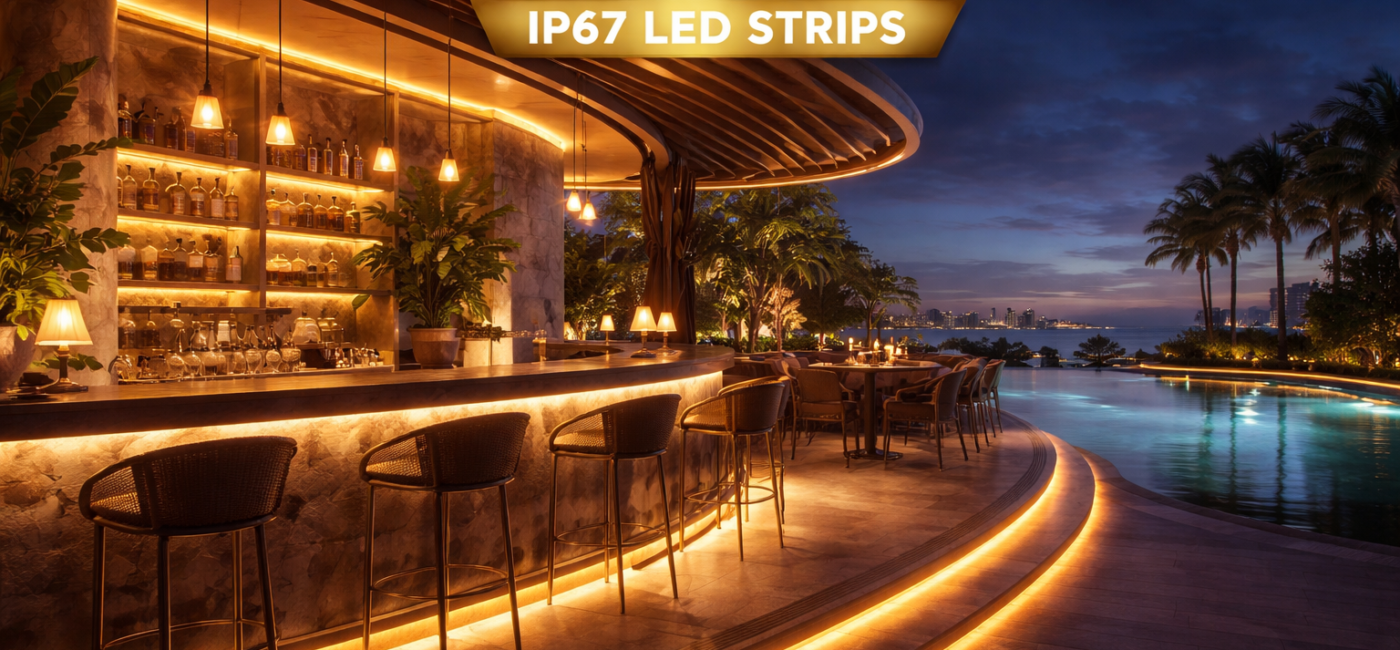
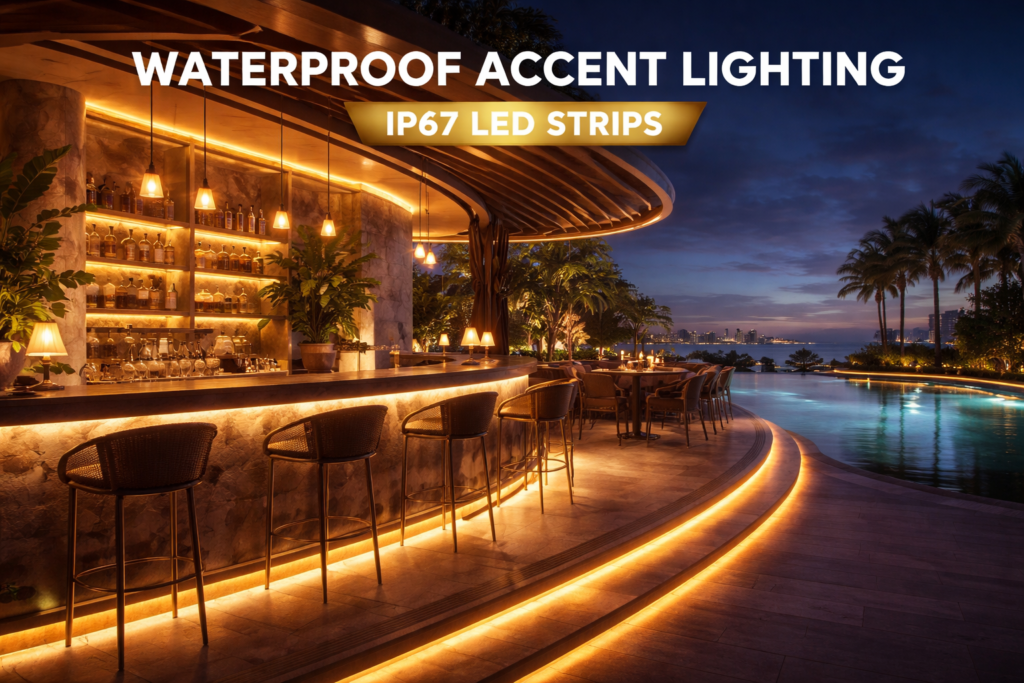
Walk into a modern café, boutique, or reception lobby in Doha today and you’ll notice something subtle—but powerful. It’s not just “more light.” It’s layered light: soft lines under counters, a glow tracing shelves, and crisp highlights that make materials feel richer. In 2026, this shift is being led by accent lighting that’s built to last, and the star of the show is the IP67 LED strip—waterproof, dust-resistant, and designed for real commercial life in Qatar’s climate.
But here’s the part most people miss: the best-looking lighting project isn’t only about the strip. It’s the full system—protection ratings, power quality, cable routing, and backup readiness—working together.
This blog breaks down what’s trending now, and how to plan installations that look premium and perform reliably using:
- IP20 & IP67 LED strip lights (AKTO)
- Proper routing via EMT, GI conduits & accessories in Qatar
- Smart reliability planning with lead acid batteries (Terminator, Bright Cell)
Why Waterproof Accent Lighting Is Booming in 2026
Accent lighting used to be “nice to have.” In 2026, it’s a business tool—because it affects how long customers stay, what they notice, and what they photograph.
The biggest 2026 trends shaping commercial lighting
- Architectural lines over decorative fixtures
Designers are moving away from “one big chandelier” and toward clean, continuous light lines that frame walls, steps, shelving, and joinery. - More demanding environments
Even “indoor” commercial spaces face humidity near entrances, frequent cleaning, dust, and heavy footfall—especially in malls, restaurants, and service counters. - Smarter lighting expectations
Connected lighting and human-centric concepts are increasingly mentioned in market outlooks, driven by energy efficiency and smart-city direction.
This is where IP67 shines—literally and technically.
IP20 vs IP67 LED Strip Lights: Choosing What Actually Fits the Space
Let’s keep it simple:
IP20 (common for interiors)
Choose IP20 when the strip is:
- Installed in dry, protected indoor areas
- Hidden inside profiles or coves away from cleaning and moisture
- Used for shelving, display niches, and controlled environments
IP67 (commercial-grade peace of mind)
Choose IP67 when the strip is:
- Near entrances, glass façades, wash areas, or humid zones
- Exposed to regular cleaning or accidental splashes
- Installed outdoors, semi-outdoors, signage, or landscape edges
- In dusty or demanding areas where sealing extends lifespan
In Qatar’s conditions—heat, dust, and humidity—IP67 is often a smart “install once, enjoy longer” approach for commercial projects.
Where IP67 Accent Lighting Looks the Best (and Works the Hardest)
If you’re planning a commercial fit-out, here are 2026-friendly applications that clients love:
- Reception desks & feature counters: soft underglow that feels premium
- Retail shelving: highlights products without glare
- Staircases & skirting lines: safer navigation + high-end finish
- Outdoor dining edges & terraces: weather-ready ambience
- Signage outlines & architectural frames: clean, modern visibility
A big reason these look “expensive” is because LED strips create continuous light, not hot spots—especially when paired with proper channels and diffusion.
Spotlight: IP20 & IP67 LED Strip Lights by AKTO (What Specifiers Like)
In 2026, specifiers are paying more attention to warranty, stability, and long-life claims, not just brightness. AKTO’s waterproof strip specs commonly emphasize commercial-grade expectations like IP67 protection and long service life.
Practical tip: In commercial projects, don’t only ask “Is it IP67?”
Also ask:
- What driver/power supply is recommended?
- What installation method keeps seals intact?
- What profile/channel is used to manage heat and keep the line clean?
The Hidden Hero: EMT, GI Conduits & Accessories in Qatar
Great lighting looks effortless. The wiring behind it should be even more effortless to maintain.
For commercial spaces, clean routing is not optional—it’s what keeps the installation:
- safer
- easier to troubleshoot
- more resistant to heat and mechanical wear
- compliant with professional expectations
That’s why EMT, GI conduits & accessories in Qatar remain a core part of modern lighting builds—especially when LED strips expand across longer runs (counters, shelves, corridors, façades).
What’s trending in conduit planning in 2026 projects
- Neater, modular routing to support future layout changes
- Better segregation between power and control lines for smart lighting
- Stronger protection in service corridors, kitchens, plant rooms, and outdoor transitions
When your lighting is designed as “architecture,” your cable management has to match.
Reliable Power Matters: Lead Acid Batteries in Commercial Backup Planning
Accent lighting is often tied into signage, emergency circulation routes, access control areas, or retail operations. Even when the main lighting is fine, power fluctuations and outages can still disrupt:
- essential low-voltage systems
- routers/controllers
- access points
- signage and key lighting zones
This is why many commercial sites still rely on lead acid batteries in UPS and backup applications—because they’re proven, widely serviceable, and cost-effective.
Brands frequently stocked and referenced locally
- Terminator sealed lead acid battery lines are commonly listed with standard capacities used in backup systems.
- Bright Cell sealed lead-acid batteries are also sold in Qatar market listings for multiple capacities.
Where this connects to LED strip lighting:
If your LED strips are part of a system that must remain stable (signage, key zones, control systems), you plan the lighting and the backup strategy together.
A Simple “Looks Great + Lasts Long” Checklist (No Overthinking)
If you want a modern, use this checklist:
- Use IP20 for dry, protected interiors
- Use IP67 where moisture, dust, cleaning, or outdoor exposure is real
- Specify quality strip + quality driver/power supply (flicker and early failure often come from power issues)
- Route professionally using EMT, GI conduits & accessories in Qatar for durability and serviceability
- For critical systems, plan lead acid battery backup (Terminator, Bright Cell) as part of the electrical strategy
Closing: The New Era Is “Beautifully Practical”
Waterproof accent lighting isn’t just a style move anymore—it’s a durability move. In Qatar’s commercial spaces, IP67 LED strip lighting is becoming the go-to choice because it delivers that high-end glow and stands up to real-world conditions. Pair it with well-planned EMT, GI conduits & accessories in Qatar, and support the system with dependable lead acid batteries (Terminator, Bright Cell) where continuity matters—and you’ve got a 2026-ready setup that looks premium and performs like it should.
FAQs
Are IP67 LED strips only for outdoors?
No. IP67 is also a smart choice indoors where cleaning, humidity, or dust is common—like entrances, wash areas, food service zones, and high-maintenance commercial interiors.
Will IP67 strips look different from IP20?
The “look” depends more on the profile, diffuser, and LED type than the IP rating. Many IP67 solutions deliver clean architectural lines when installed correctly.
Why mention EMT and GI conduits in a lighting trend article?
Because modern lighting is a system. In commercial spaces, the most successful projects are the ones that are easy to expand, repair, and maintain—conduit and accessories make that possible.
Are lead acid batteries still relevant in 2026?
Yes—especially for UPS/backup scenarios where proven, serviceable battery tech is preferred. Many commercial setups still use sealed lead-acid formats.