Understand Pricing, Indoor vs Outdoor Use, Installation Essentials, and Long-Term Value of IP20 & IP67 LED Strip Lights
If you’re shopping for IP20 & IP67 LED strip lights, you’ll notice pricing can look all over the place—because you’re not only paying for “a strip,” you’re paying for brightness, LED density, chip type (COB vs SMD), color quality, waterproofing method, brand reliability, and the installation ecosystem (drivers, controllers, channels, wiring protection, etc.).
This blog breaks down typical costs, what drives the price up or down, and how to budget for a complete, clean installation—especially in Qatar, where heat, dust, and outdoor exposure can change what “good value” looks like.
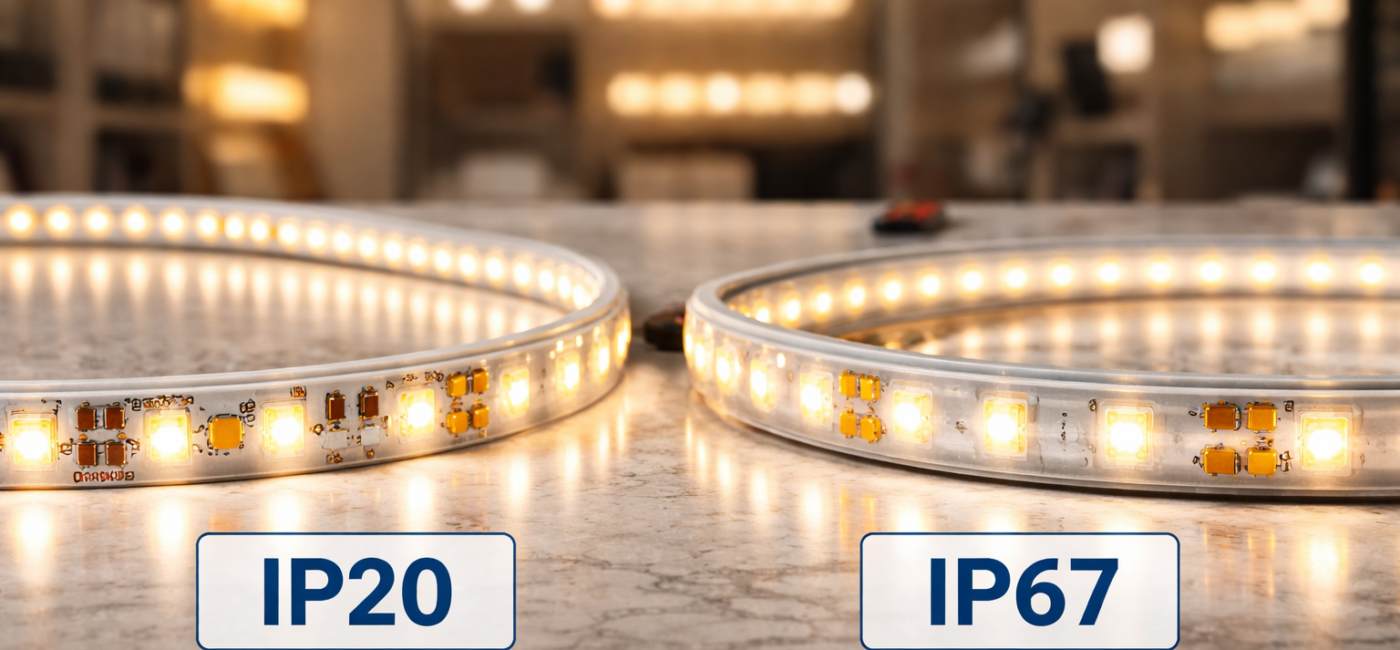
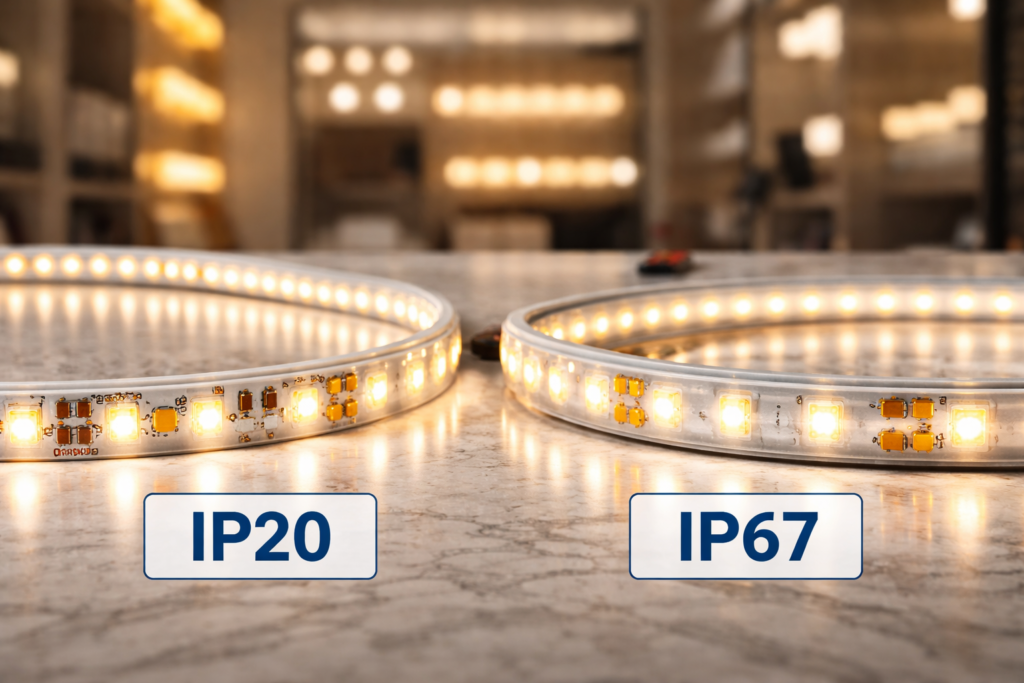
Quick Understanding: IP20 vs IP67 (Why the Price Gap Exists)
- IP20 LED strip lights: indoor-rated, protected from fingers/large objects, not water-resistant. Common for cove lighting, shelves, wardrobes, bedrooms, retail displays.
- IP67 LED strip lights: sealed to resist dust and immersion up to 1 meter for limited time (manufacturer specifics vary). Used for outdoor edges, façades, pergolas, wet areas, pool surrounds (with the right spec), washdown zones, marine-ish environments.
Why IP67 usually costs more: the strip needs better sealing (silicone sleeve, injected silicone, or epoxy), stronger connectors, and often heavier-duty materials—plus extra QC so water doesn’t creep in and ruin the run.
Typical Price Ranges (What You’ll Usually Pay)
Think of LED strip pricing in two layers:
- The strip itself (per meter or per 5m roll)
- The “system cost” (driver, controller, profiles, wiring, protection, installation)
1) Typical strip-only costs (per meter)
These are realistic ranges you’ll commonly see across markets, and they match what you’ll observe locally when comparing different specs/brands:
IP20 LED strip lights (indoor) — typical range
- Budget/basic SMD strips: ~QAR 5–15 per meter
- Mid-range (better LED density, stable drivers, decent CRI): ~QAR 15–35 per meter
- Premium (high CRI, high density, COB “dotless,” brand-grade bins): ~QAR 35–80+ per meter
Local example (Qatar listing): a 5m COB IP20 strip listed at QAR 88 (works out to ~QAR 17.6/m if priced as a 5m roll).
IP67 LED strip lights (waterproof) — typical range
- Budget IP67 (basic sealing, lower density): ~QAR 12–30 per meter
- Mid-range IP67 (better sealing + reliability): ~QAR 30–70 per meter
- Premium IP67 (high-output, high CRI, engineered outdoor longevity): ~QAR 70–140+ per meter
Reality check: In marketplaces, you’ll also see very low per-meter claims—especially for long reels or “mains voltage rope/neon” styles. Those can be fine for decorative use, but for professional installs you’ll want to verify spec sheets, voltage drop behavior, warranty terms, and connector sealing.
Qatar Shopping Context: Real-World Price Signals You Can Reference
To ground the “typical range” in something you can actually compare today:
- A Qatar lighting retailer shows 5m COB IP20 strip pricing around QAR 88 for a specific model/spec.
- A Qatar-based seller/brand page is actively marketing IP20 & IP67 LED strip lights as cost-effective solutions (useful as a local intent signal, even when product-level pricing varies by spec).
- General marketplaces show IP67 strips in many formats (including neon/rope styles), but pricing fluctuates with LED density, voltage type, and included accessories.
The key takeaway: in Qatar, a “normal” indoor IP20 strip can start around the teens per meter, while IP67 typically starts higher and rises fast when you demand high output + clean diffusion + long-life sealing.
The 9 Biggest Factors That Change the Cost of IP20 & IP67 LED Strip Lights
1) LED type: SMD vs COB (and why COB often costs more)
- SMD: individual LED dots visible unless diffused.
- COB: “chip-on-board,” looks more continuous/dotless, often favored for premium interiors.
COB strips often carry a premium because they look cleaner in modern architectural lighting.
2) LED density (LEDs per meter)
More LEDs per meter typically means:
- smoother light
- higher brightness potential
- higher power draw
- higher cost
3) Brightness (lumens per meter) and wattage (W/m)
Higher brightness and higher W/m need:
- better thermal management
- better driver sizing
- sometimes thicker copper PCB
4) Color quality (CRI and consistency)
If you want high CRI (90+) for homes, retail, and hospitality, you’ll pay more.
5) Voltage: 12V vs 24V vs 48V
- 24V usually performs better on longer runs (less voltage drop than 12V).
- 48V systems can be even better for long continuous runs (often premium-grade setups).
6) IP67 sealing method (this is huge)
Not all IP67 is created equal. Common approaches:
- silicone sleeve + end caps
- silicone top-coating
- full injection molding/encapsulation
Better sealing (and better connectors) costs more—but saves you from the “one rainy week killed the whole run” pain.
7) Brand + warranty terms
A no-name strip might be cheaper, but if it shifts color, fails early, or delaminates outdoors, you’ll pay twice.
8) Accessories included (connectors, clips, controllers)
Some listings look expensive because they bundle:
- dimmer/controller
- power supply
- connectors
Always separate “strip-only” cost from “kit” cost.
9) Installation method (channel vs raw strip)
If you want a premium finish, budget for:
- aluminum profile/channel
- diffuser
- end caps
- mounting clips
This can meaningfully add to the per-meter installed cost.
“Installed Cost” in Qatar: A More Honest Budget
Most people underestimate the system cost. Here’s a practical way to budget a project using IP20 & IP67 LED strip lights.
Typical add-ons beyond the strip:
- LED driver/power supply (sized to wattage + safety headroom)
- Controller/dimmer (if RGB/RGBW/tunable white)
- Aluminum profile + diffuser
- Wiring + connectors
- Protection + routing: this is where EMT, GI conduits & accessories in Qatar can matter a lot for tidy, durable work
- Labor (cutting, soldering, sealing, testing, routing, commissioning)
Ballpark “installed” ranges (varies by complexity and spec)
- IP20 installed (indoor): often ends up around ~2× to 4× the strip-only cost
- IP67 installed (outdoor/wet): often ~2.5× to 5× the strip-only cost due to sealing, routing, and protection needs
If you’re installing outdoors in Qatar (heat + dust + occasional washdown exposure), the “cheap strip, messy wiring” approach fails faster—so spending on installation quality is often the smarter long-term savings.
Why EMT, GI Conduits & Accessories in Qatar Belong in This Conversation
A clean LED strip job isn’t just about the strip—it’s about how the wiring and power delivery are protected.
EMT (Electrical Metallic Tubing)
- Often used indoors for neat, protected routing
- Helps prevent cable damage
- Makes maintenance easier later
GI conduits (Galvanized Iron) & accessories
- Common for tougher environments
- Better suited for harsher exposure zones when installed correctly
- Accessories (couplers, saddles, inspection boxes, bends) can make the job look professional and reduce failure points
How this ties to cost:
When you choose IP67 strips for outdoors, you should also treat the wiring path as outdoor-grade. Better conduit work costs more upfront, but it reduces:
- water ingress to joints
- cable insulation damage
- “mystery flicker” caused by compromised connections
So yes—EMT, GI conduits & accessories in Qatar can be a hidden line item that separates a premium build from a constant-maintenance build.
Backup Power Angle: Where Lead Acid Batteries (Terminator, Bright Cell) Fit
In certain sites—shops, signage, emergency ambiance lighting, or facilities that want continuity—people sometimes add backup power.
That’s where lead acid batteries (including commonly stocked brands like Terminator and Bright Cell) show up in the conversation. They’re used in:
- UPS systems
- emergency lighting circuits
- backup for critical accent lighting or signage
Why this affects your LED strip budget
If you want even partial backup runtime for LED strips, you may need:
- a UPS/inverter or DC backup system
- charging/control circuitry
- battery housing/ventilation considerations
- additional protections/fusing
This is not required for most home installs, but in commercial environments it can be a strategic add-on—especially if the LED strips are part of branding or customer experience.
(Important note: battery backup design should be sized and installed by qualified professionals to match load, runtime, and safety requirements.)
Cost Examples (Easy Budget Scenarios)
Scenario A: Indoor cove lighting (IP20, warm white, 10 meters)
You buy:
- 10m IP20 strip
- 1–2 drivers (depending on wattage)
- aluminum profile + diffuser
- wiring + basic control (optional)
Typical spend pattern: strip looks cheap, but the profile + driver + installation makes the final cost feel “real.”
Scenario B: Outdoor pergola outline (IP67, 20 meters)
You buy:
- 20m IP67 strip
- outdoor-safe drivers/enclosures
- sealed connectors/end caps
- routing via GI conduit or protected paths
- proper mounting + diffusion to avoid hotspots
Typical spend pattern: IP67 material cost is higher, and labor + protection adds more than you expect.
Scenario C: Retail shelves + backup glow (IP20 + UPS/battery)
You buy:
- IP20 strips for shelves
- drivers + dimming
- cable management (often EMT indoors)
- UPS and lead acid batteries (e.g., Terminator / Bright Cell) sized for runtime
Typical spend pattern: battery system can become a major line item—sometimes bigger than the LED strips themselves.
How to Shop Smart (Without Overpaying)
1) Compare by spec, not by “meters”
When comparing two “5m strips,” check:
- W/m
- lumens/m
- CRI
- LED density
- voltage (12/24/48)
- warranty
2) For IP67, zoom in on the weak points
Ask or check for:
- connector sealing method
- end-cap sealing
- cut-point resealing instructions
- recommended silicone/adhesive for joints
3) Don’t skip aluminum profiles for premium interiors
Profiles:
- improve heat dissipation
- make the light look smoother
- protect the strip
4) Budget drivers properly
Under-sized drivers cause flicker, early failure, or overheating. A safe planning habit is leaving headroom rather than running drivers at max load continuously
Final Takeaway
- IP20 LED strip lights are typically the more budget-friendly option, commonly landing from single digits to a few dozen QAR per meter, with premium COB/high-CRI options going higher. A local Qatar example shows ~QAR 17.6/m based on a 5m IP20 COB listing at QAR 88.
- IP67 LED strip lights typically cost more—often starting in the teens to several dozen QAR per meter, rising substantially for high-output, high-CRI, long-life outdoor-grade builds.
- Your installed cost can be 2× to 5× the strip price once you add drivers, profiles, wiring protection, and labor—especially outdoors where EMT, GI conduits & accessories in Qatar make the job safer and more durable.
- If you add backup power, lead acid batteries ( like Terminator and Bright Cell) can shift the budget significantly, depending on runtime goals.