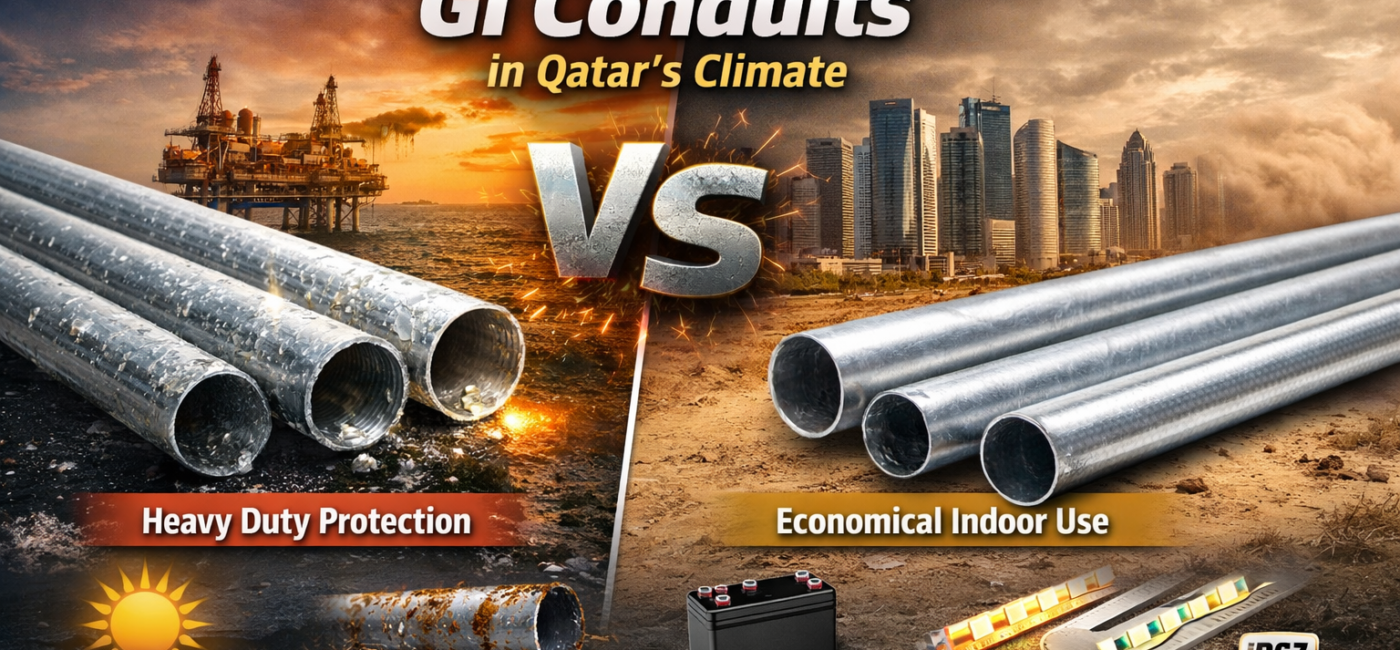
Qatar’s rapid infrastructure growth has transformed the country into one of the Middle East’s most advanced construction markets. From high-rise commercial towers in West Bay to industrial complexes in Ras Laffan and smart developments in Lusail, modern projects demand electrical systems that are durable, compliant, and built to withstand extreme environmental stress.
At the heart of every reliable electrical system lies a crucial component: the conduit network.
When sourcing EMT, GI conduits & accessories in Qatar, contractors and consultants frequently face a critical decision:
Should you use Hot-Dip Galvanized (HDG) GI conduits or Pre-Galvanized GI conduits?
While both are widely used across residential, commercial, and industrial projects, their performance in Qatar’s harsh climate differs significantly. This comprehensive guide explores their differences in corrosion resistance, cost efficiency, compliance suitability, lifecycle value, and real-world applications.
Understanding Qatar’s Climate and Its Impact on GI Conduits
Before comparing galvanization types, it’s important to understand the environmental challenges specific to Qatar.
Extreme Heat Exposure
Summer temperatures often exceed 50°C in exposed areas. Rooftop installations and external walls experience even higher surface temperatures due to direct solar radiation. Steel materials expand, contract, and undergo continuous stress cycles.
Coastal Humidity and Salt Content
With much of Qatar’s development near coastal zones such as Doha, Lusail, and Al Wakrah, saline air significantly accelerates corrosion in metallic systems. Salt particles combined with humidity create aggressive oxidation conditions.
Industrial and Chemical Exposure
Industrial zones like Mesaieed and Ras Laffan expose materials to airborne chemicals, vapors, and high operational loads. These environments demand higher corrosion resistance.
Condensation Inside Buildings
Air-conditioned interiors combined with hot external temperatures create condensation risks, especially in service shafts and basement installations.
These environmental factors make the selection of EMT, GI conduits & accessories in Qatar far more than a budget decision — it becomes a performance and safety strategy.
What Are GI Conduits?
GI (Galvanized Iron) conduits are steel pipes coated with zinc to protect against corrosion. They serve as protective channels for electrical wiring in:
- Commercial buildings
- Residential towers
- Warehouses and logistics centers
- Hospitals and schools
- Data centers
- Oil & gas facilities
- Renewable energy installations
The zinc coating prevents rust and prolongs service life. However, the method of galvanization determines performance quality.
What Is Hot-Dip Galvanized (HDG) GI Conduit?
Hot-Dip Galvanizing involves immersing fully fabricated steel conduits into molten zinc at approximately 450°C. This process forms a thick zinc-iron alloy layer that metallurgically bonds to the steel surface.
Key Characteristics of HDG Conduits
- Thick zinc coating (50–85+ microns)
- Full internal and external protection
- High corrosion resistance
- Strong surface adhesion
- Excellent performance in aggressive environments
In Qatar, HDG conduits are commonly specified for:
- Outdoor installations
- Coastal buildings
- Industrial facilities
- Rooftop cable routing
- Solar projects
- External lighting systems including IP67 LED strip lights
What Is Pre-Galvanized GI Conduit?
Pre-Galvanized conduits are manufactured from zinc-coated steel sheets before the pipe is formed. The zinc layer is thinner compared to HDG.
Key Characteristics of Pre-Galvanized Conduits
- Moderate corrosion resistance
- Smooth finish
- Economical pricing
- Suitable for indoor installations
Pre-Galvanized GI conduits are widely used in:
- False ceiling systems
- Office interiors
- Retail spaces
- Indoor commercial wiring
- Installations using IP20 LED strip lights
Direct Comparison: Hot-Dip vs Pre-Galvanized GI Conduits in Qatar
When choosing between the two for EMT, GI conduits & accessories in Qatar, a clear side-by-side comparison helps determine suitability based on climate and application.
Technical & Environmental Comparison Table
| Comparison Factor | Hot-Dip Galvanized (HDG) GI Conduit | Pre-Galvanized GI Conduit |
|---|---|---|
| Galvanization Process | Immersed in molten zinc after fabrication | Zinc-coated sheet before forming |
| Zinc Coating Thickness | Thick (50–85+ microns) | Thinner coating |
| Corrosion Resistance | Excellent – resists humidity & salt | Moderate – suitable for dry areas |
| Coastal Suitability in Qatar | Highly recommended | Not ideal for long-term exposure |
| Outdoor Applications | Strongly recommended | Limited use |
| Industrial Environments | Ideal for oil & gas & warehouses | Not preferred |
| Mechanical Durability | High impact resistance | Moderate strength |
| Expected Lifespan in Qatar | 20+ years | 8–12 years (indoor use) |
| Maintenance Requirement | Low | Medium |
| Initial Cost | Higher | Lower |
| Long-Term ROI | Excellent lifecycle value | Cost-effective for indoor use |
| Inspection Approval | Higher confidence for infrastructure | Suitable mainly for interior works |
When Should You Choose Hot-Dip Galvanized in Qatar?

Hot-Dip Galvanized GI conduits are the preferred option in:
- Coastal projects near the Arabian Gulf
- External façade lighting installations
- Rooftop solar systems
- Warehouses with open ventilation
- Oil & gas processing plants
- Battery backup rooms containing Lead acid batteries
In environments where humidity and salt are unavoidable, HDG significantly reduces long-term corrosion risk.
When Is Pre-Galvanized GI Conduit Sufficient?
Pre-Galvanized conduits remain practical for:
- Indoor commercial projects
- Office towers with centralized air-conditioning
- Retail outlets and malls
- Concealed false ceiling installations
- Light-duty wiring systems
For installations involving indoor IP20 LED strip lights, Pre-Galvanized or EMT systems provide adequate protection.
The Role of EMT in Qatar’s Electrical Infrastructure
EMT (Electrical Metallic Tubing) is lighter and easier to install compared to GI conduit. It is widely used in commercial interiors where mechanical stress is limited.
In Qatar’s rapidly expanding retail and hospitality sectors, EMT is commonly selected for:
- Fast-track fit-outs
- Partition walls
- Suspended ceiling systems
However, EMT is not recommended for heavy industrial or exposed outdoor environments unless additional protection is provided.
Compliance Standards for GI Conduits in Qatar
Electrical installations must comply with:
- Qatar Construction Specifications (QCS)
- Kahramaa regulations
- Qatar Civil Defence requirements
- IEC & BS standards
Many infrastructure and government projects require higher corrosion resistance levels, making Hot-Dip Galvanized conduits a safer compliance choice.
Selecting certified EMT, GI conduits & accessories in Qatar ensures smoother inspection approvals and reduced project delays.
Integration with Modern Electrical Systems
Today’s buildings integrate advanced technologies including:
- Smart lighting systems
- Structured data networks
- Emergency lighting
- UPS systems
- Renewable energy integration
- Energy storage solutions using Lead acid batteries
Battery rooms generate heat and require reliable grounding. Corrosion-resistant conduit systems enhance operational safety and longevity.
For outdoor architectural lighting projects using IP67 LED strip lights, durable GI conduits protect wiring from moisture and environmental exposure.
Importance of High-Quality Accessories
A conduit system’s performance depends not only on the pipe but also on its fittings and accessories.
Couplings, bends, saddles, locknuts, and junction boxes must match the galvanization level of the conduit. Mixing HDG conduits with low-grade accessories can create corrosion points.
Trusted brands in Qatar such as Terminator, Bright Cell, and AKTO provide reliable electrical components suitable for Gulf conditions. Using reputable brands improves durability and project credibility.
Lifecycle Cost Analysis: Short-Term vs Long-Term Value
Pre-Galvanized conduits may reduce upfront costs by 10–20%. However, in harsh environments, maintenance and replacement costs may offset initial savings.
Hot-Dip Galvanized systems offer:
- Extended lifespan
- Reduced maintenance
- Lower risk of premature failure
- Stronger structural reliability
For long-term infrastructure projects, lifecycle value often outweighs initial budget considerations.
Sustainability and Green Building Considerations
Qatar promotes sustainable construction under GSAS guidelines. Steel-based conduit systems support sustainability through recyclability and durability.
Hot-Dip Galvanized conduits reduce material waste due to longer lifespan, contributing to environmentally responsible development.
Choosing high-quality EMT, GI conduits & accessories in Qatar aligns with long-term sustainability goals.
Final Recommendation: What Works Best in Qatar?
The best solution depends on project conditions.
For indoor, climate-controlled environments, Pre-Galvanized GI conduits or EMT systems provide cost-effective performance.
For coastal, industrial, or outdoor installations exposed to humidity and salt, Hot-Dip Galvanized GI conduits are strongly recommended.
In Qatar’s demanding climate, corrosion is inevitable if protection is inadequate. Investing in the right conduit system ensures electrical safety, regulatory compliance, and infrastructure durability for decades.